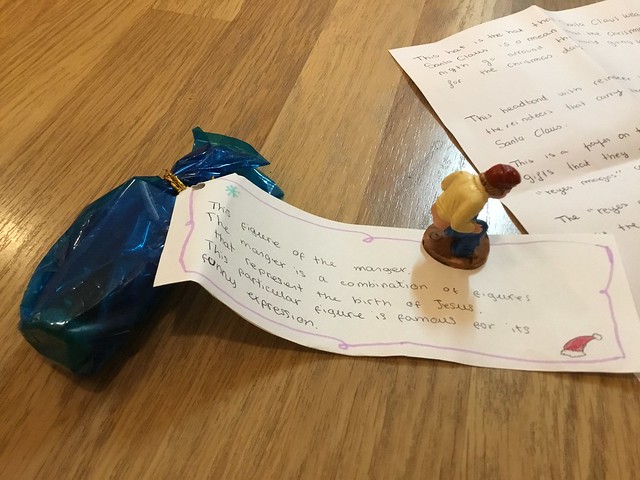
These were the questions and these are the answers:


World of Water. Global Scholars.
Institut Rafael Casanova

Our peers in Seoul have received our Christmas Box, but they have some questions.
This is the e-mail their teacher, Jeonkang, sent me:
Hello, Mireia.
Last Monday, we finally opened your box and happily enjoyed all the items you gave us. Thank you so much.
My students liked the figures most and wondered why you put the funny but a little embarrassing figures under the Christmas tree. Can you tell the reason more?
Next week is the Lunar New Year’s holiday so right after the holidays, we sent you a culture box. I’m going to enclose items with explanations in a letter.
I hope you’ll enjoy the box.
See you soon. Have a nice weekend.
Last term we exchanged a video with our peers in Seoul and we’ve now had a chance to watch the video they sent us.
This is where you can reflect on what we have watched. You can add a text about what surprised you most or what you have researched. Add photos or videos, as well, so that you can illustrate it better.
Your peers at Mott Hall Charter School in Bronx, NYC were very happy to receive your letters, objects and explanations about sports in Sant Boi, Barcelona and/or Catalonia.

Now you’ll see what they gave us in exchange.
Read carefully and share your insights, a summary of what you read or see, a picture illustrating what they tell you, etc. Remember to sign your contributions.


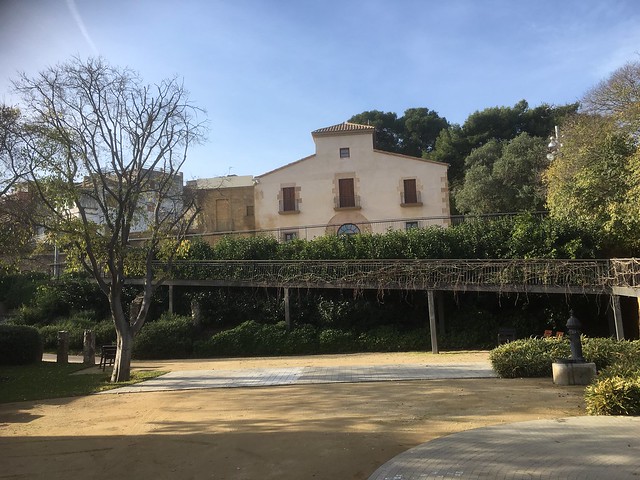
On December 10 and 11 we went to Can Julià, a historic local farmhouse which is now the River Interpretation Center. We met two guides, Laia nd Marina. First of all, we went to the 2nd floor to play a giant board game. The board was a river, our river: the Llobregat river. There were the middle and lower course parts of the river and the river mouth. We scored points depending on the cards we had to read on each square. We scored points if we read about positive actions for the river, such as repopulating it with native fauna. We did not score any points if we read about negative actions, such as polluting the river with toxic waste from factories.
After the break we went downstairs and the guides told us about the exhibition panels: Llobregat river is 170km long, its spring is in Castellar de n’Hug, there are stones (sediments) which can filter water but others can’t, etc.
The last part was the funniest: experimenting. We looked into microorganisms using a scientific magnifying glass, we played with jigsaw puzzles to learn about the river flora and fauna, we experimented with water and sediments to see which rocks and stones filtered water, and we also created a delta with sand and water.
Finally, we played tag outdoors. There were 2 teams: the true team and the false team. The guide said something about what we had learned about the river and if it was true, teh true team had to catch someone from the false team; and the other way round if what the guide said was false.
Unfortunately, because of the recent rainfall, we could not go to the river for field research, but we are going in spring.
Now that we’re finishing term 1 and you have to hand in your Global Scholars dossier, a question is raised: Which are the characteristics of a good dossier?
These were your answers:
Class C

Class B

Fill in the pre-check list and assess yourself. Use the list as a guide for your final dossier.
This is the rubric which we will use for peer assessment.