Here you’ve got a very useful link from the British Council, where you will find lots of information of all kinds about CLIL methodology.
Regards,
F.

Here you’ve got a very useful link from the British Council, where you will find lots of information of all kinds about CLIL methodology.
Regards,
F.
Benvolguts/des,
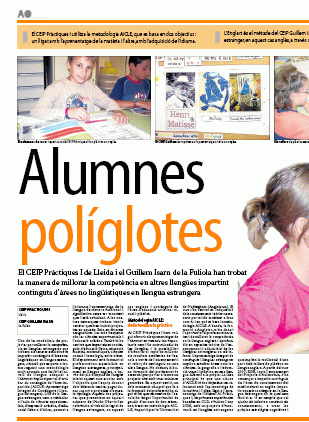
L’any passat ens van publicar al diari de la nostre ciutat, un petit article sobre la metodologia que estem implantant a l’escola (AICLE). Passat un temps, hem aconseguit la versió PDF de l’article per tal de poder compartir-lo amb tothom a través de mitjans on-line.
Talk to you later.
F.
[kml_rm movie=”http://video.xtec.cat:8080/ramgen/edu3tv/video/videoteca/practicompartida/7325.rm” width=”425″ height=”344″/]
Un vídeo interessant que parla d’una experiència duta a terme en un centre del nostre país. Projecte CLIL. Matemàtiques i ciències en anglès .[kml_rm movie="http://video.xtec.cat:8080/ramgen/edu3tv/video/videoteca/practicompartida/7346.rm" width="425" height="344"/]
Dear all,
here you will find materials designed by Catalan teachers in CLIL training courses (University of Nottingham).

Dear colleagues, I think this webpage is awesome! You’ve got flash presentations, activities and ideas for your very own lessons.


Aqui hi podreu trobar algunes unitats CLIL i materials diversos sobre metodologia AICLE.
Aqui us deixo una mostra de pàgines web de gran utilitat per programar unitats CLIL. Ànims.
http://www.primaryresources.co.uk/

http://www.primarylanguages.org.uk/Teachers/

http://www.coxhoe.durham.sch.uk/


The basis of CLIL (Content and Language Integrated Learning) is that new subject content from other curriculum areas is taught and learnt through the new language. In other words, children’s learning experience is enhanced by exploiting the links between the two subjects. Since it is used for real purposes, the new language is also learned more ‘naturally’ thus building on other forms of learning. As the subject content should always be the main focus of the CLIL lesson, children should be encouraged to draw on their knowledge about language in order to make sense of new concepts. CLIL is based on language acquisition so children’s fluency is more important than accuracy. Existing subject lesson plans have to be modified to take into account children’s ability in the new language, and therefore the planning process is vital.
