
Mes: març de 2019
Unit 4. Digital Project: Water Issues Infographic
In the Water Issues Survey digital project, students will survey members of the community to learn about the water issues that are most important to them and the actions they would take to address the issue. Then, students will create an infographic to share their findings and reflections. The resources on this page will help students brainstorm, create, and share their work with Global Scholars peers.
MAKE A PLAN
Now that you have your survey data, plan what your infographic will look like. What will your title be? Which photos will you use? Where will you put the chart and graph? Remember to save room for your reflection and solutions.
On a piece of paper, draw what you would like your infographic to look like. Below is an example of all the pieces you should include in your drawing.
Your Reflection
Your Solution
CREATE
Now that you have your survey data, plan, and reflections, put them together to create your infographic.
Share your reflections from page 74.
Create a chart and graph. You can use a digital tool or the worksheet on the back of your survey handout to do this. Create and label:
1. A pie chart for Survey Question 1
2. A bar graph for Survey Question 2
Add captioned photos to illustrate your project. Show your photos to your teacher to make sure it’s okay to use them!
Recommend solutions to address the issues you identified in the survey. Make sure the solutions you recommend match the types of actions your community members are willing to do.
Now that you have your survey
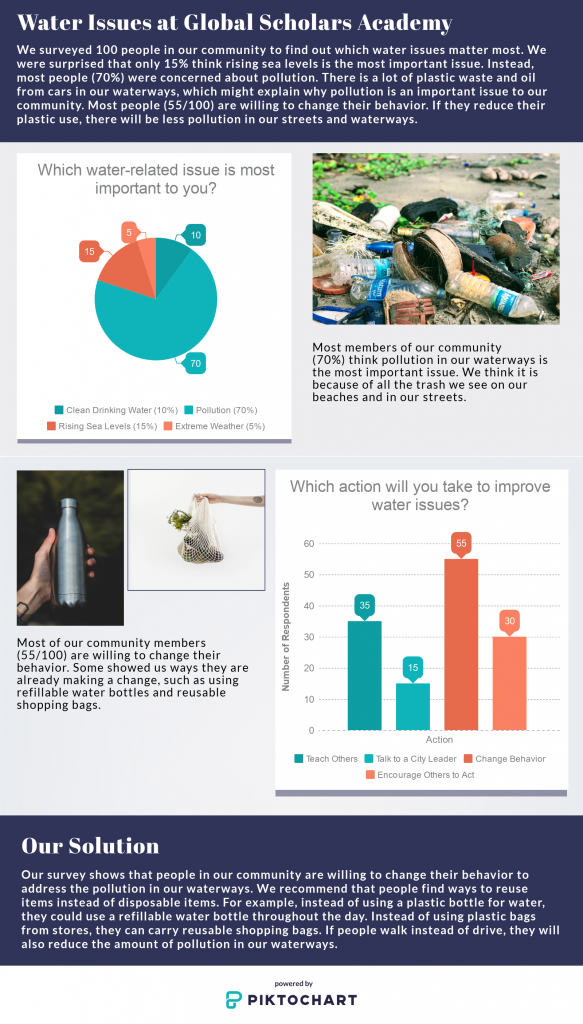
An infographic is s visual way to share information.
Infographics fit on one page and include photos, graphs, text, and charts.
Review the infographic example:
Unit 4. Climate Change News
Choose the article you like the most and read it:
Ten catastrophes threatening Spain
https://www.thelocal.es/20151130/climate-change-catastrophes-spain-is-currently-facing
Animal Migration
https://www.sciencedaily.com/news/earth_climate/climate/
Glacier Melt
https://www.theguardian.com/environment/2019/jan/18/north-america-glacier-melt-study-climate-change
Extreme Weather
https://www.theguardian.com/world/natural-disasters
Greenhouse gases
https://www.bbc.com/news/topics/c302m85q187t/greenhouse-gas-emissions
https://www.nytimes.com/topic/subject/greenhouse-gas-emissions
Marine Life
Sea Levels
https://www.sciencenews.org/article/ice-sheets-collapse-sea-level-rise-climate-change
Wildfire
https://www.bbc.com/news/topics/ce2gz9mdde3t/wildfires
Floods
https://www.euronews.com/tag/flood
Droughts
https://www.euronews.com/tag/drought
Hurricanes
https://www.usnews.com/topics/subjects/hurricanes
Typhoons
https://www.straitstimes.com/tags/typhoonshurricanes
Coral Bleaching
Unit 4. Climate Change
Climate change ia a global water issue that impacts water security for people in our city and around the world. Today, we are going to analyse some local news articles to learn how climate change impacts your city and find out more about the potential impacts of climate change so we know what evidence to look for in the news articles.
DISCUSS
1. What impacts of climate change are surprising to you?
2. Have you seen some of these impacts in your city?
3. What questions do you still have about climate change in your city?
https://climatekids.nasa.gov/climate-change-meaning/
https://kids.nationalgeographic.com/explore/science/climate-change/
https://www.natgeokids.com/au/discover/geography/general-geography/what-is-climate-change/
https://www.unicef.ca/en/climate-change-and-childrens-rightshttps://www.sciencedaily.com/news/earth_climate/climate/
Articles
Climate Change

A polar bear walks along a rocky shore, looking for food. The bear would usually be on the sea ice hunting for seals, pouncing when the seal comes up to breathe. But the ice has started to melt earlier and re-form later than it has in the past. Without the sea ice, the polar bear must scavenge for other, less nutritious food.Polar bears are affected by climate change.
These changes in polar sea ice are a result of climate change. But this isn’t
ju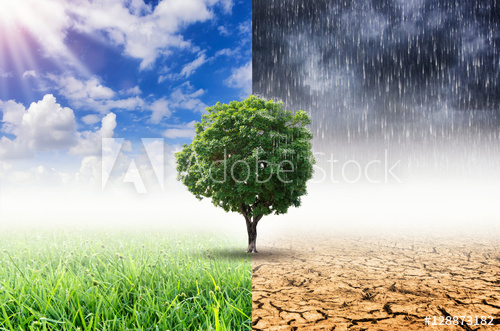
Weather changes day to day—sometimes it rains, other days it’s hot. Climate is the pattern of the weather conditions over a long period of time for a large area. And climate can be affected by Earth’s atmosphere.
Our Earth is surrounded by an atmosphere made up of gases. When sunlight enters our atmosphere, some of the sun’s heat is trapped by the gas, and some bounces back out into space. By trapping that heat, our atmosphere keeps Earth warm enough to live on. Without it, our planet would be very cold, like Mars.
Earth’s climate has always naturally cycled through change, caused by how much of the sun’s energy was absorbed by the atmosphere. In fact over the past 650,000 years, the Earth has gone through seven ice ages and warming periods.
What’s different now?
Factories emit carbon dioxide.
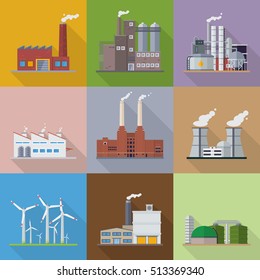
But during the past few hundred years, oil, gas, and coal have powered homes, cars, and factories. These energy sources release a gas called carbon dioxide into the atmosphere. This gas traps heat that would otherwise escape Earth’s atmosphere. That increases Earth’s temperature, which contributes to the planet’s warming.
That’s why many scientists agree that the Earth is now warming because of human activity. How do they know? Through careful study, they know that the climate is warming about 10 times faster than the average previous warming times. They’ve also ruled out the natural factors that caused warming in the past.
The Earth’s average temperature has increased about 1.5°F in the past hundred years. It doesn’t sound like much, but scientists think that the temperature increase has caused melting glaciers, drought, and coral reef die-off. (Coral can’t survive in water that’s too warm.) They expect the climate will warm another .5°F to 8.6°F by the year 2100.
What could happen?
Climate change affects more than temperature. Warmer water changes the patterns of ocean currents, affecting global weather patterns.
Some places will receive more rainfall, which could lead to flooding, while other places will get less, which might mean drought. Tropical storms could be stronger, and a continuing rise in sea level due to melting polar ice might push people out of their homes.
Hundreds of plant and animal species have already experienced changes because of climate change. The American pika, for example, is a small mammal that lives in cool mountainous areas in western North America—in fact, it can die when exposed to temperatures warmer than 78˚F. So as the mountain climate heats up, the pika climbs the slopes in search of cooler habitat. But what happens when temperatures at the top become too warm for the pika?
Other species will benefit from a warmer world—but in some cases that would be bad news for humans. Because disease-carrying mosquitoes thrive in warm, wet weather, more people could contract illnesses such as malaria as the Earth warms.
What can we do about it?
You can do a lot! It’s simple to make a difference to keep the Earth healthy. Try some of these tips to reduce the amount of carbon dioxide you add to the atmosphere.
- Instead of traveling in a car, use public transportation, walk, or ride your bike when you can. Biking or walking 10 miles each day instead of riding in a car can save up to 1.9 tons of carbon dioxide from entering the atmosphere every year.
- Reduce and reuse things as much as possible. Factories emit lots of carbon dioxide when making new products. (Buying products that are made with recycled glass and plastic also emits carbon dioxide, though less so.) Fix your appliances and clothes instead of buying new products. Good thing holey jeans are back in style!
- Wash your clothes in cold water, and hang them to dry.
- Electronics use energy even when they’re turned off, so unplug them when you’re not using them. It could save your family about $200 a year on its energy bill.
- Eat less meat and dairy. Farm animals, er, emit another heat-trapping gas, methane. And some studies have found that livestock account for about half of the world’s heat-trapping gas emissions.
- Buy locally grown and in-season foods and products to reduce emissions from transporting products.
- Wear a warm sweater at home in the winter instead of turning up the heat, and open your windows instead of blasting the air conditioning in the summer.
- Talk to your parents and the other adults that you know about climate change. Send a letter or drawing to your mayor, Senate or House representative, or even to the president. These leaders can vote to regulate and reduce carbon dioxide emissions.