A support to my Math class
Symmetries of Quadrilaterals
A line that reflects a figure onto itself is called a line of symmetry. A figure that can be carried onto itself by a rotation is said to have rotational symmetry.
Every four‐sided polygon is a quadrilateral. Some quadrilaterals have additional properties and are given special names like squares, parallelograms and rhombuses. A diagonal of a quadrilateral is formed when opposite vertices are connected by a line segment. In this task you will use rigid‐motion transformations to explore line symmetry and rotational symmetry in various types of quadrilaterals.
1. A rectangle is a quadrilateral that contains four right angles. Is it possible to reflect or rotate a rectangle onto itself?
For the rectangle shown below, find
•any lines of reflection, or
•any centers and angles of rotation
that will carry the rectangle onto itself.

Describe the rotations and/or reflections that carry a rectangle onto itself. (Be as specific as possible in your descriptions.)
2. A parallelogram is a quadrilateral in which opposite sides are parallel. Is it possible to reflect or rotate a parallelogram onto itself? For the parallelogram shown below, find
•any lines of reflection, or
•any centers and angles of rotation
that will carry the parallelogram onto itself.
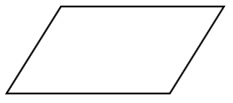
Describe the rotations and/or reflections that carry a parallelogram onto itself. (Be as specific as possible in your descriptions.)
3. A rhombus is a quadrilateral in which all sides are congruent. Is it possible to reflect or rotate a rhombus onto itself?
For the rhombus shown below, find
•any lines of reflection, or
•any centers and angles of rotation
that will carry the rhombus onto itself.
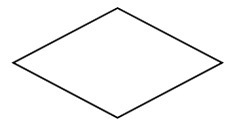 Describe the rotations and/or reflections that carry a rhombus onto itself. (Be as specific as possible in your descriptions.)
4. A square is both a rectangle and a rhombus. Is it possible to reflect or rotate a square onto itself?
For the square shown below, find
•any lines of reflection, or
•any centers and angles of rotation
that will carry the square onto itself.

Describe the rotations and/or reflections that carry a rhombus onto itself. (Be as specific as possible in your descriptions.)
5. A trapezoid is a quadrilateral with one pair of opposite sides parallel. Is it possible to reflect or rotate a trapezoid onto itself?
Draw a trapezoid based on this definition. Then see if you can find
•any lines of symmetry, or
•any centers of rotational symmetry
that will carry the trapezoid you drew onto itself.
If you were unable to find a line of symmetry or a center of rotational symmetry for your trapezoid,
see if you can sketch a different trapezoid that might possess some type of symmetry.
Leave a Reply