Mr. Iglesias' Math Class
A support to my Math class
1. What do you think about Zac’s claim? Do you think every isosceles triangle has a line of symmetry? If so, what convinces you this is true? If not, what concerns do you have about his statement?
2. What else would Zac need to know about the line through the vertex point of the angle made up of the two congruent sides and the midpoint of the third side in order to know that it is a line of symmetry? (Hint: Think about the definition of a line of reflection.)
3. Sione thinks Zac’s “crease line” (the line formed by folding the isosceles triangle in half) creates two congruent triangles inside the isosceles triangle. Which criteria—ASA, SAS or SSS—could she use to support this claim? Describe the sides and/or angles you think are congruent, and explain how you know they are congruent.
4. If the two triangles created by folding an isosceles triangle in half are congruent, what does that imply about the “base angles” of an isosceles triangle (the two angles that are not formed by the two congruent sides)?
5. If the two triangles created by folding an isosceles triangle in half are congruent, what does that imply about the “crease line”? (You might be able to make a couple of claims about this line—one claim comes from focusing on the line where it meets the third, non‐congruent side of the triangle; a second claim comes from focusing on where the line intersects the vertex angle formed by the two congruent sides.)

Zac and Sione are trying to decide how much information they need to know about two triangles before they can convince themselves that the two triangles are congruent.
They are wondering if knowing that two angles and the included side of one triangle are congruent to the corresponding two angles and the included side of another triangle—a set of criteria their teacher refers to as ASA—is enough to know that the two triangles are congruent. They are trying to justify that this would be so.
To start reasoning about the congruence of the two triangles, Zac and Sione have created the following diagram in which they have marked an ASA relationship between the triangles.

1.Based on the diagram, which angles have Zac and Sione indicated are congruent? Which sides?
2. To convince themselves that the two triangles are congruent, what else would Zac and Sione need to know?
Zac’s Argument
“I know what to do,” said Zac. “We can translate point A until it coincides with point R, then rotate AB about point R until it coincides with RS. Finally, we can reflect triangle ABC across RS and then everything coincides so the triangles are congruent.” [Zac and Sione’s teacher has suggested they use the word “coincides” when they want to say that two points or line segments occupy the same position on the plane. They like the word, so they plan to use it a lot.]
What do you think about Zac’s argument? Does it convince you that the two triangles are congruent? Does it leave out any essential ideas that you think need to be included?
3. Write a paragraph explaining your reaction to Zac’s argument:
Sione isn’t sure that Zac’s argument is really convincing. He asks Zac, “How do you know point C coincides with point T after you reflect the triangle?”
4. How do you think Zac might answer Sione’s question?
While Zac is trying to think of an answer to Sione’s question he adds this comment, “And you really didn’t use all of the information about the corresponding congruent parts of the two triangles.”
“What do you mean?” asked Zac.
Sione replied, “You started using the fact that angle A is congruent to angle R when you translated triangle ABC so that the vertex A coincides with vertex R. And you used the fact that AB is congruent to RS when you rotated AB to coincide with RS, but where did you use the fact that angle B is congruent to angle S?
“Yeah, and what does it really mean to say that two angles are congruent?” Zac added. “Angles are more than just their vertex points.”5.How might thinking about Zac and Sione’s questions help improve Zac’s argument?
Sione’s Argument
“I would start the same way you did, by translating point A until it coincides with point R, rotating AB about point R until it coincides with RS, and then reflecting triangle ABC across RS”, Sione said. But then I would want to convince myself that points C and T coincide. I know that an angle is made up of two rays that share a common endpoint. Since I know that AB coincides with RS and angle A is congruent to angle R, that means that AC coincides with RT. Likewise, I know that BA coincides with SR and angle B is congruent to angle S, so BC must coincide with ST. Since AC and BC intersect at point C, and RT and ST intersect at point T, points C and T must also coincide because the corresponding rays coincide. Therefore, BC is congruent to ST, CA to TR, and angle C to angle T because both angles are made up of rays that coincide!”
At first Zac was confused by Sione’s argument, but he drew diagrams and carefully marked and sketched out each of his statements until it started to slowly make sense.
6. Do the same kind of work that Zac did to make sense of Sione’s argument. What parts of his argument are unclear to you? What ideas did sketching out the words of his proof help you to clarify?
Sione’s argument suggests that ASA is sufficient criteria for determining if two triangles are congruent. Now Zac and Sione are wondering about other criteria, such as SAS or SSS, or perhaps even AAA (which Zac immediately rejects because he thinks two triangles can have the same angle measures but be different sizes)
7. Draw two triangles that have SAS congruence. Be sure to mark you triangles to show which sides and which angles are congruent.
8. Write out a sequence of transformations to show that the two triangles potentially coincide.
9. If Sione were to examine your work in #8, what questions would he wonder about?
10. How can you use the given congruence criteria (SAS) to resolve Simone’s wonderings?
Repeat 7‐10 for SSS congruence.
The two quadrilaterals shown below, quadrilateral ABCD and quadrilateral QRST are congruent, with corresponding congruent parts marked in the diagrams.
Describe a sequence of rigid-motion transformations that will carry quadrilateral ABCD onto quadrilateral QRST. Be very specific in describing the sequence and types of transformations you will use so that someone else could perform the same series of transformations.

We have found that many different quadrilaterals possess line and/or rotational symmetry.
In the following chart, write the names of the quadrilaterals that are being described in terms of their symmetries.

Based on the symmetries we have observed in various types of quadrilaterals, we can make claims about other features and properties that the quadrilaterals may possess.
1. A rectangle is a quadrilateral that contains four right angles.
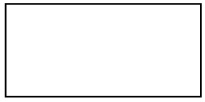
Based on what you know about transformations, what else can we say about rectangles besides the defining property that all four angles are right angles? Make a list of additional properties of rectangles that seem to be true based on the transformation(s) of the rectangle onto itself. You will want to consider properties of the sides, the angles, and the diagonals.
2. A parallelogram is a quadrilateral in which opposite sides are parallel
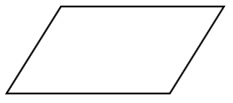
Based on what you know about transformations, what else can we say about parallelograms besides the defining property that opposite sides of a parallelogram are parallel? Make a list of additional properties of parallelograms that seem to be true based on the transformation(s) of the parallelogram onto itself. You will want to consider properties of the sides, angles and the diagonals.
3. A rhombus is a quadrilateral in which all four sides are congruent.
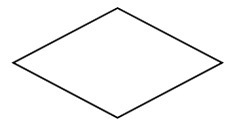
Based on what you know about transformations, what else can we say about a rhombus besides the defining property that all sides are congruent? Make a list of additional properties of rhombuses that seem to be true based on the transformation(s) of the rhombus onto itself. You will want to consider properties of the sides, angles and the diagonals.
4. A square is both a rectangle and a rhombus
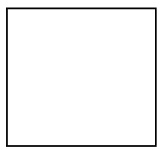
Based on what you know about transformations, what can we say about a square? Make a list of properties of squares that seem to be true based on the transformation(s) of the squares onto itself. You will want to consider properties of the sides, angles and the diagonals.
In the following chart, write the names of the quadrilaterals that are being described in terms of their features and properties, and then record any additional features or properties of that type of quadrilateral you may have observed. Be prepared to share reasons for your observations.

What do you notice about the relationships between quadrilaterals based on their characteristics and highlighted in the structure of the above chart?
How are the charts at the beginning and end of this task related? What do they suggest?
A line that reflects a figure onto itself is called a line of symmetry.
A figure that can be carried onto itself by a rotation is said to have rotational symmetry.
A diagonal of a polygon is any line segment that connects non‐consecutive vertices of the polygon.
For each of the following regular polygons, describe the rotations and reflections that carry it onto itself: (be as specific as possible in your descriptions, such as specifying the angle of rotation)
1. An equilateral triangle

2. A square

3. A regular pentagon

4. A regular hexagon
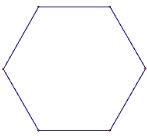
5. A regular octagon

6. A regular nonagon

What patterns do you notice in terms of the number and characteristics of the lines of symmetry in a regular polygon?
What patterns do you notice in terms of the angles of rotation when describing the rotational symmetry in a regular polygon?
A line that reflects a figure onto itself is called a line of symmetry. A figure that can be carried onto itself by a rotation is said to have rotational symmetry.
Every four‐sided polygon is a quadrilateral. Some quadrilaterals have additional properties and are given special names like squares, parallelograms and rhombuses. A diagonal of a quadrilateral is formed when opposite vertices are connected by a line segment. In this task you will use rigid‐motion transformations to explore line symmetry and rotational symmetry in various types of quadrilaterals.
1. A rectangle is a quadrilateral that contains four right angles. Is it possible to reflect or rotate a rectangle onto itself?
For the rectangle shown below, find
•any lines of reflection, or
•any centers and angles of rotation
that will carry the rectangle onto itself.
Describe the rotations and/or reflections that carry a rectangle onto itself. (Be as specific as possible in your descriptions.)
2. A parallelogram is a quadrilateral in which opposite sides are parallel. Is it possible to reflect or rotate a parallelogram onto itself? For the parallelogram shown below, find
•any lines of reflection, or
•any centers and angles of rotation
that will carry the parallelogram onto itself.
Describe the rotations and/or reflections that carry a parallelogram onto itself. (Be as specific as possible in your descriptions.)
3. A rhombus is a quadrilateral in which all sides are congruent. Is it possible to reflect or rotate a rhombus onto itself?
For the rhombus shown below, find
•any lines of reflection, or
•any centers and angles of rotation
that will carry the rhombus onto itself.
Describe the rotations and/or reflections that carry a rhombus onto itself. (Be as specific as possible in your descriptions.)4. A square is both a rectangle and a rhombus. Is it possible to reflect or rotate a square onto itself?
For the square shown below, find
•any lines of reflection, or
•any centers and angles of rotation
that will carry the square onto itself.
Describe the rotations and/or reflections that carry a rhombus onto itself. (Be as specific as possible in your descriptions.)
5. A trapezoid is a quadrilateral with one pair of opposite sides parallel. Is it possible to reflect or rotate a trapezoid onto itself?
Draw a trapezoid based on this definition. Then see if you can find
•any lines of symmetry, or
•any centers of rotational symmetry
that will carry the trapezoid you drew onto itself.
If you were unable to find a line of symmetry or a center of rotational symmetry for your trapezoid,
see if you can sketch a different trapezoid that might possess some type of symmetry.
Part 1
Carlos and Clarita are discussing their latest business venture with their friend Juanita. They have created a daily planner that is both educational and entertaining. The planner consists of a pad of 365 pages bound together, one page for each day of the year. The planner is entertaining since images along the bottom of the pages form a flip‐book animation when thumbed through rapidly. The planner is educational since each page contains some interesting facts. Each month has a different theme, and the facts for the month have been written to fit the theme. For example, the theme for January is astronomy, the theme for February is mathematics, and the theme for March is ancient civilizations. Carlos and Clarita have learned a lot from researching the facts they have included, and they have enjoyed creating the flip‐book animation.
The twins are excited to share the prototype of their planner with Juanita before sending it to printing. Juanita, however, has a major concern. “Next year is leap year,” she explains, “you need 366 pages.”
So now Carlos and Clarita have the dilemma of having to create an extra page to insert be tween February 28 and March 1. Here are the planner pages they have already designed.

Since the theme for the facts for February is mathematics, Clarita suggests that they write formal definitions of the three rigid‐motion transformations they have been using to create the images for the flip‐book animation.
How would you complete each of the following definitions?
1. A translation of a set of points in a plane . . .
2. A rotation of a set of points in a plane . . .
3. A reflection of a set of points in a plane . . .
4. Translations, rotations and reflections are rigid motion transformations because . . .
Carlos and Clarita used these words and phrases in their definitions: perpendicular bisector, center of rotation, equidistant, angle of rotation, concentric circles, parallel, image, pre‐image, preserves distance and angle measures.
Revise your definitions so they also use these words or phrases.
Part 2
In addition to writing new facts for February 29, the twins also need to add another image in the middle of their flip‐book animation. The animation sequence is of Dorothy’s house from the Wizard of Oz as it is being carried over the rainbow by a tornado. The house in the February 28 drawing has been rotated to create the house in the March 1 drawing. Carlos believes that he can get from the February 28 drawing to the March 1 drawing by reflecting the February 28 drawing, and then reflecting it again.

Verify that the image Carlos inserted between the two images that appeared on February 28 and March 1 works as he intended. For example,
• What convinces you that the February 29 image is a reflection of the February 28 image about the given line of reflection?
•What convinces you that the February 29 image is a reflection of the February 28 image about the given line of reflection?
•What convinces you that the two reflections together complete a rotation between the February 28 and March 1 images?

Josh is animating a scene where a troupe of frogs is auditioning for the Animal Channel reality show, “The Bayou’s Got Talent”. In this scene the frogs are demonstrating their “leap frog” acrobatics act. Josh has completed a few key images in this segment, and now needs to describe the transformations that connect various images in the scene.
For each pre‐image/image combination listed below, describe the transformation that moves the pre‐image to the final image.
• If you decide the transformation is a rotation, you will need to give the center of rotation, the direction of the rotation (clockwise or counterclockwise), and the measure of the angle of rotation.
• If you decide the transformation is a reflection, you will need to give the equation of the line of reflection.
• If you decide the transformation is a translation you will need to describe the “rise” and “run” between pre‐image points and their corresponding image points.
• If you decide it takes a combination of transformations to get from the pre‐image to the final image, describe each transformation in the order they would be completed.
| Pre-Image | Final Image | Description |
| image 1 | image 2 | |
| image 2 | image 3 | |
| image 3 | image 4 | |
| image 1 | image 5 | |
| image 2 | image 4 |
In Leaping Lizards you probably thought a lot about perpendicular lines, particularly when rotating the lizard about a 90° angle or reflecting the lizard across a line.
In previous tasks, we have made the observation that parallel lines have the same slope. In this task we will make observations about the slopes of perpendicular lines. Perhaps in Leaping Lizards you used a protractor or some other tool or strategy to help you make a right angle. In this task we consider how to create a right angle by attending to slopes on the coordinate grid.
We begin by stating a fundamental idea for our work: Horizontal and vertical lines are perpendicular. For example, on a coordinate grid, the horizontal line y = 2 and the vertical line x = 3 intersect to form four right angles.
But what if a line or line segment is not horizontal or vertical?
How do we determine the slope of a line or line segment that will be perpendicular to it?
Experiment 1
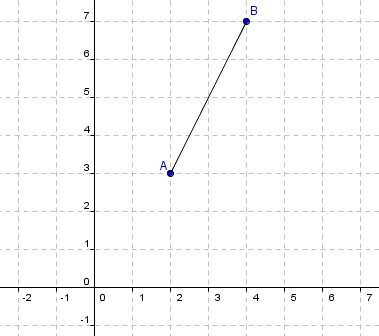
1. Consider the points A (2, 3) and B (4, 7) and the line segment, AB, between them.
What is the slope of this line segment?
2. Locate a third point C (x, y) on the coordinate grid, so the points A (2, 3), B(4, 7) and C (x, y) form the vertices of a
right triangle, with AB as its hypotenuse.
3. Explain how you know that the triangle you formed contains a right angle?
4. Now rotate this right triangle 90° about the vertex point (2, 3). Explain how you know that you have rotated the triangle 90°.
5. Compare the slope of the hypotenuse of this rotated right triangle with the slope of the hypotenuse of the pre‐image. What do you notice?
Experiment 2
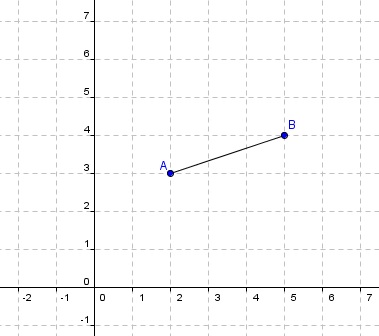
Repeat steps 1‐5 above for the points A (2, 3) and B (5, 4).
Animated films and cartoons are now usually produced using computer technology, rather than the hand-drawn images of the past. Computer animation requires both artistic talent and mathematical knowledge.
Sometimes animators want to move an image around the computer screen without distorting the size and shape of the image in any way. This is done using geometric transformations such as translations (slides), reflections (flips), and rotations (turns) or perhaps some combination of these. These transformations need to be precisely defined, so there is no doubt about where the final image will end up on the screen.
So where do you think the lizard shown on the grid on the following page will end up using the following transformations? (The original lizard was created by plotting the following anchor points on the coordinate grid and then letting a computer program draw the lizard. The anchor points are always listed in this order: tip of nose, center of left front foot, belly, center of left rear foot, point of tail, center of rear right foot, back, center of front right foot.)

Original lizard anchor points:
{(12,12),(15,12), (17,12), (19,10),(19,14),(20,13), (17,15), (14,16)}
Each statement below describes a transformation of the original lizard.
Do the following for each of the statements:
•plot the anchor points for the lizard in its new location
•connect the preimage and image anchor points with line segments, or circular arcs, whichever best illustrates the relationship between them
Lazy Lizard
Translate the original lizard so the point at the tip of its nose is located at (24,20), making the lizard appears to be sunbathing on the rock.
Lunging Lizard
Rotate the lizard 90° about point A(12,7) so it looks like the lizard is diving into the puddle of mud.
Leaping Lizard
Reflect the lizard about given line y = x/2 + 16 so it looks like the lizard is doing a back flip over the cactus.
So,
Who to work with? You will work with your elbow partner, but each one of you will have to turn in the assignment. I WILL ONLY CHECK ONE OF THEM, so make sure that you agree with your partners’ work!
What materials do I need? The GeoGebra file “Leaping Lizards” has been shared with you in your Drive/Math1/Module 6 folder.
What do I need to turn in? You will have to turn in
– Three GeoGebra files titled Lazy Lizard, Lunging Lizard, and Leaping Lizard. Share those 3 files with me. Remember to name the files: Math1_PeriodX_Last Name_Title.
– A presentation titled “Conclusions” for each one of the three transformations. You can use the following sentences frames:
I recommend you to take a look at Prezi or Thinglink to create your presentations.
How am I going the be given a grade? Here is the rubric for the activity:
| 1 point | 2 points | 3 points | 4 points | |
| Lazy Lizard | Translation is shown | Translation is shown, and some image points are shown | Translation is shown, and all preimage/image points are connected | Translation is shown, all preimage/image points are connected correctly |
| Lunging Lizard | Rotation is shown | Rotation is shown, and some image points are shown | Rotation is shown, and all preimage/image points are connected | Rotation is shown, all preimage/image points are connected correctly |
| Leaping Lizard | Reflection is shown | Reflection is shown, and some image points are shown | Reflection is shown, and all preimage/image points are connected | Reflection is shown, all preimage/image points are connected correctly |
| Conclusions | Some coclusions are extracted | Some coclusions are extracted, and justified | Coclusions for all three transformations are extracted, and some justified correctly | Coclusions for all three transformations are extracted, and justified correctly |

Recent Comments