A support to my Math class
Is It Right?
In Leaping Lizards you probably thought a lot about perpendicular lines, particularly when rotating the lizard about a 90° angle or reflecting the lizard across a line.
In previous tasks, we have made the observation that parallel lines have the same slope. In this task we will make observations about the slopes of perpendicular lines. Perhaps in Leaping Lizards you used a protractor or some other tool or strategy to help you make a right angle. In this task we consider how to create a right angle by attending to slopes on the coordinate grid.
We begin by stating a fundamental idea for our work: Horizontal and vertical lines are perpendicular. For example, on a coordinate grid, the horizontal line y = 2 and the vertical line x = 3 intersect to form four right angles.
But what if a line or line segment is not horizontal or vertical?
How do we determine the slope of a line or line segment that will be perpendicular to it?
Experiment 1
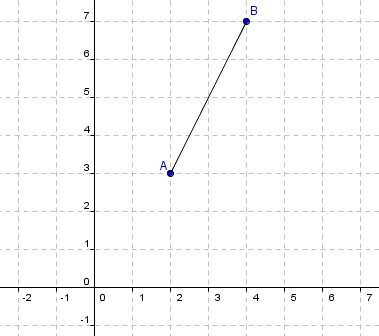
1. Consider the points A (2, 3) and B (4, 7) and the line segment, AB, between them.
What is the slope of this line segment?
2. Locate a third point C (x, y) on the coordinate grid, so the points A (2, 3), B(4, 7) and C (x, y) form the vertices of a
right triangle, with AB as its hypotenuse.
3. Explain how you know that the triangle you formed contains a right angle?
4. Now rotate this right triangle 90° about the vertex point (2, 3). Explain how you know that you have rotated the triangle 90°.
5. Compare the slope of the hypotenuse of this rotated right triangle with the slope of the hypotenuse of the pre‐image. What do you notice?
Experiment 2
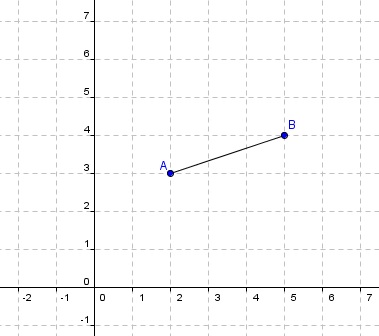
Repeat steps 1‐5 above for the points A (2, 3) and B (5, 4).
Leave a Reply