8 de març

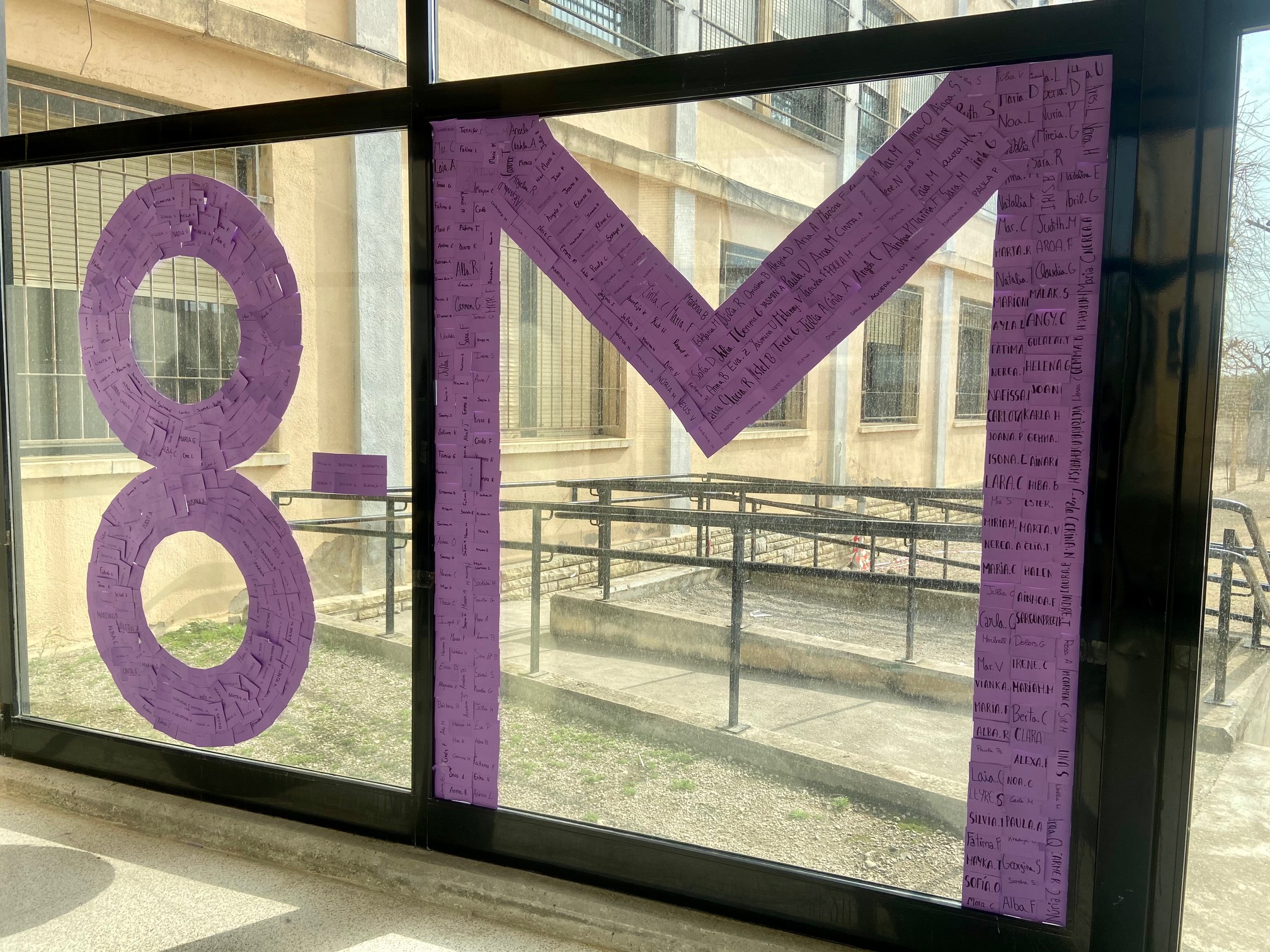
L’alumnat de 3r B, com a activitat del Servei Comunitari, ha volgut fer un mural per reivindicar el Dia Internacional de les Dones. Al mural hi som representades les 552 dones que formem part de l’Institut Dertosa (alumnes, professores, PAS i personal de neteja).
Aquesta no serà l’única actuació que es portarà a terme a l’Institut relacionada amb el 8 de març, el Departament de Visual i Plàstica està preparant diverses activitats que podrem anar veient durant tot el mes de març.

Tot seguit teniu un petit vídeo on alumnat de 3r ens explica breument què reivindiquem aquest dia.

The International Working Women’s Day

Our Students in grade 4 (4t ESO D humanístic, in Catalan) held an interesting online lecture in English on Thursday 4th March to talk about the International Working Woman’s Day. They watched several short films on women in Asian countries, whose life goes through great legal difficulties related to forced marriages or sexual harassment. The lesson can be watched online in the following link.

George Orwell’s life and work

Several first class of Baccalaureate students have been studying George Orwell’s life and work, one of the greatest 20th century British writers, who wrote lots of books about civil rights and people’s dignity. Eric Arthur Blair (25 June 1903 – 21 January 1950), known by his pen name George Orwell, was an English novelist, essayist, journalist and critic.His work is characterised by lucid prose, biting social criticism, opposition to totalitarianism and outspoken support of democratic socialism. He published Homage to Catalonia, after his experience in spring 1937 during the Civil War. After watching this video we can get a good insight about his writing style and the ideals he supported during his professional career as a journalist and a writer.

The old man at the bridge

Our students in Grade 4, who are following their humanistic or artistic studies (in Catalan 4t ESO humanístic/artístic), have made a recording based on the historical tale “The old man at the bridge” by American 1954 Nobel Prize Winner Ernest Hemingway. It was based on the bombing of the Amposta bridge during the 1936-1939 Civil War.
After reading the tale and analysing its historical messages, a few of them translated it into Catalan. Finally, a video in both English and Catalan was recorded on the bank of the river.