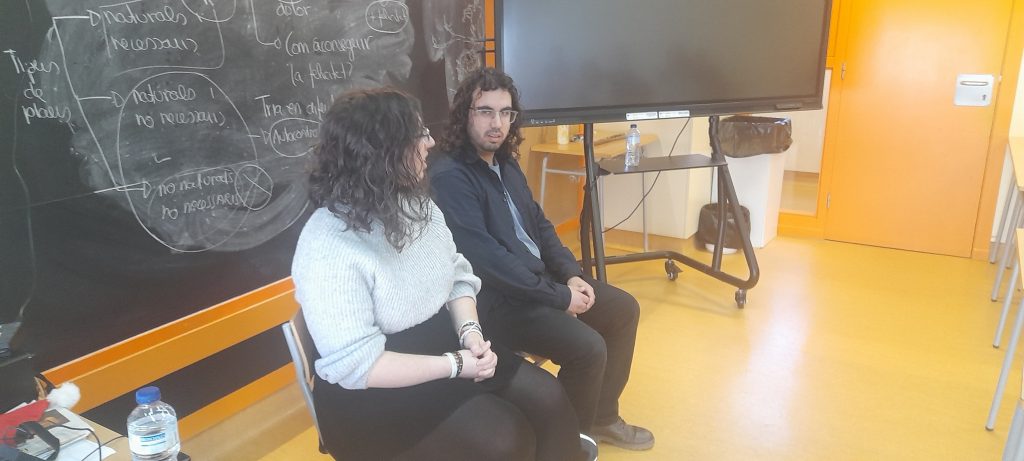
Two experts on video games

Today, the 2nd Year sixth form students at Institut Dertosa had the pleasure of welcoming Alba Ramos and Hèctor Rubio, both graduates in video game creation from the Universitat Jaume I in Castelló de la Plana. This educational session provided a rich and insightful experience for our students, who had the opportunity to delve into the fascinating world of video game development.

During the session, Alba and Hèctor shared their academic and professional journey, explaining the details of the video game creation program and their specific training. They spoke about their passion for the world of video games, emphasizing the importance of creativity and the necessity of various disciplines such as music, drawing, design, and color in the development of video games.

In addition to the theoretical part, the guests conducted a practical demonstration, showcasing several video game platforms and presenting their own webpage. This hands-on component was well-received by the students, as it allowed them to see firsthand how the industry operates.
The visit of Alba Ramos and Hèctor Rubio was both motivating and inspiring for the students, who gained valuable insights into the professional opportunities within the video game creation field. This activity aligns with the center’s goals of fostering curiosity and interest among students in various disciplines, as well as providing them with practical and real-world learning opportunities.

We are very grateful to Alba and Hèctor for their visit and look forward to organizing more activities that enrich our students’ educational experience.

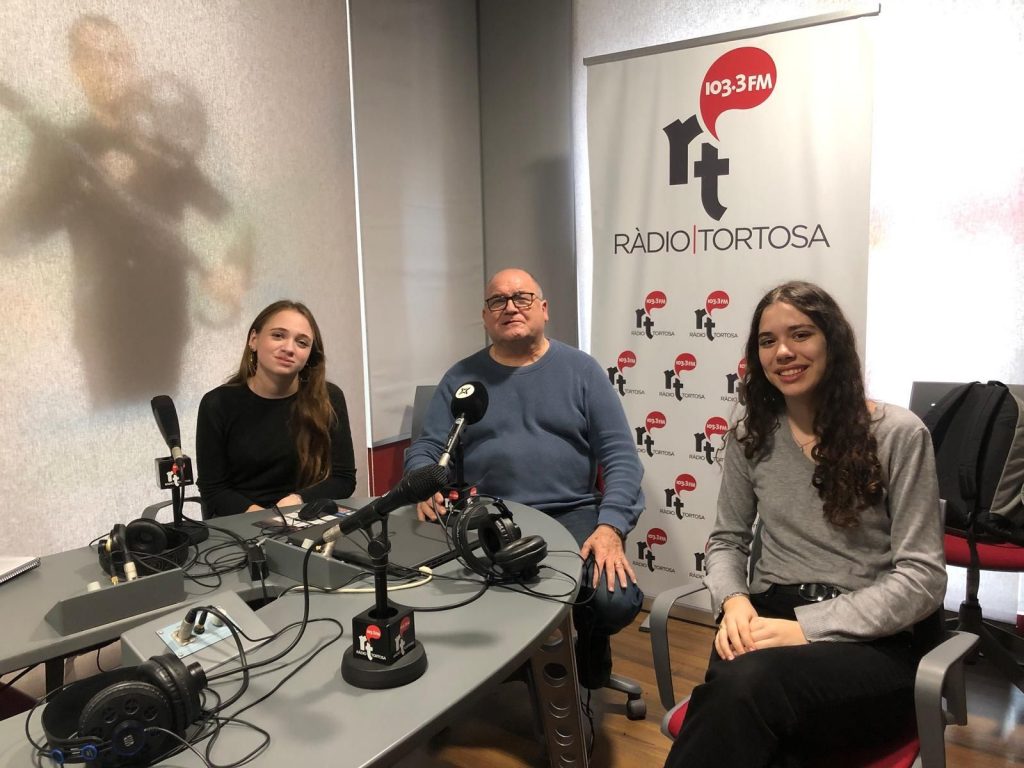
Two students in radio Tortosa


Students Laia Cugat and Maria Albacar, alongside their teacher Emigdi Subirats, recently took part in the communication segment of the program “La Punta del Diamant” hosted by Núria Mora on Ràdio Tortosa. During their appearance, they discussed their impressive second-year high school research projects, shedding light on significant historical and literary topics.

Laia Cugat presented her project titled “Voces Silenciadas”. In this assignment, written in Castilian, Laia delves into the lives and works of post-war poets who experienced internal exile during Franco’s regime, providing a fresh and necessary perspective on their contributions to Castilian literature.

Maria Albacar, on the other hand, showcased her English project, titled “Hemingway: The Last War Correspondent”. Maria explored the crucial role played by Ernest Hemingway as a war correspondent during the conflict, highlighting his experiences and influence on war narratives.

Teacher Emigdi Subirats emphasized the importance of well-executed research projects (TDR) and the depth of study they offer on researched topics, underscoring the educational value of these investigations in secondary education.

Congratulations to both students for their contribution to the program and their commitment to research and knowledge!

Literary route Sweet rumble of water in memory


On Monday, February 3rd, the picturesque Teodor González Municipal Park in Tortosa became a haven for literature and music enthusiasts. The event, “Sweet Rumble of Water in Memory,” saw the participation of first-year artistic high school students, accompanied by the enchanting violin performances of student Pau Forner.

The literary route unfolded at six significant points within the park:

  1. Central Promenade
  2. Narrow-Gauge Railway Engine
  3. Monument of Brotherhood
  4. Fountain
  5. Medieval Market
  6. Poetic Space dedicated to Gerard Vergés

During the event, students performed readings of works by English-speaking authors with connections to Tortosa. The selections included:

  • Ernest Hemingway, the last war correspondent in the city in April 1938.
  • Martin Luther King Jr., whose “Letter from Birmingham Jail” was translated into Catalan by Tortosa native Zoraida Burgos.
  • The Brontë Sisters, chosen for a research project by Amanda Cutts, a student at Institut Despuig.
  • Virginia Woolf, with one of her books translated into Catalan by professor Carme Camacho.
  • Thomas Eliot, deeply admired by local poet Gerard Vergés.

The event culminated in the reading of a translated poem by Gerard Vergés himself, bringing the journey full circle and paying homage to Tortosa’s rich literary heritage. It was a day that beautifully married the arts, leaving an indelible mark on all who attended.

This unique celebration of literature and music not only showcased the talents of the young students but also highlighted the deep cultural connections that tie Tortosa to the broader literary world.

Online talk with writer Coia Valls

Last Wednesday, February 5th, the students of 2nd year of Baccalaureate E, in the Humanistic and Performing Arts itinerary, had the opportunity to enjoy an online talk with the writer Coia Valls, from Reus. The session took place during the tutorial hour, offering the students a unique experience to get to know one of the most prominent figures in contemporary Catalan literature.

During the talk, Coia Valls spoke about her professional career, beginning with her work as a speech therapist. She then explained her transition to the artistic world, where she has excelled as a rhapsodist and novelist. The students were able to learn about the various facets of this multifaceted author and her passion for literature.

One of the most emotional moments of the session was when Coia Valls recited a poem from El jardí de les delícies by Gerard Vergés, her great literary idol. The students were captivated by her interpretation and her connection with the work of the great Tortosa poet.

Additionally, the students had the opportunity to share their own literary and artistic vocations with the author. They also discussed their research projects (TDR) of a literary nature, exchanging ideas and receiving valuable advice from the novelist.

The talk was an enriching experience for the students, who were able to delve deeper into the world of literature alongside one of the most relevant writers in the current literary scene.

The activity was part of the sTwinning “Writing is Fun” project, aimed at promoting all kinds of literary events.

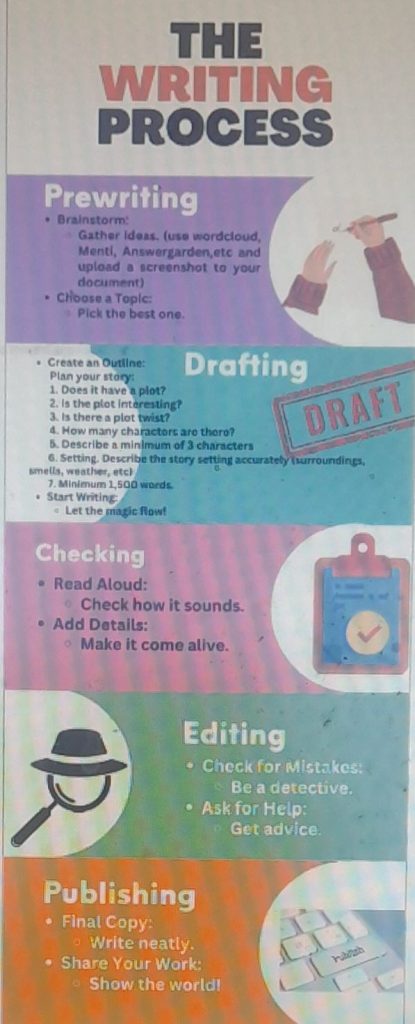
Draft outline

Once you’ve already agreed on a genre, you should start with the draft (outline):


  • Create an Outline:


       Plan your story:

  1. Does it have a plot?
  2. Is the plot interesting?
  3. Is there a plot twist?
  4. How many characters are there?
  5. Describe a minimum of 3 characters
  6. Setting. Describe the story setting accurately (surroundings, smells, weather, etc)
  7. Minimum 1,500 words.


  • Start Writing:
  • Let the magic flow!


Welcome to your team

Dear students,

Welcome to your team. This document has been prepared for your team to work collaboratively. You will be able to write your messages, your thoughts, and your collaborative story on this document. 

While working here please.


  • Be kind to your team members.
  • Use formal language, not informal or native language.
  • First, introduce yourself under the heading “INTRODUCTION OF TEAM MEMBERS”
  • Work collaboratively.
  • Choose separate colors for yourself and if you are more than one from the same school choose the same writing color with your friend. So that it can easily be seen that you are working collaboratively and internationally.
  • Write your messages under “OUR MESSAGES” headline.
  • Write your story under “OUR STORY” headline.


ENJOY YOUR TIME!


International Collaboration Update

Happy New Year to All Our eTwinning Partners!

We are excited to announce that the formation of the international groups for our project is underway. Our students will soon embark on a collaborative journey that promises to enrich their learning experiences and foster cross-cultural friendships.

Project Overview: Each student will be required to introduce themselves and indicate their preferred writing topic in a shared document. This will help us organize the groups more effectively and ensure that everyone is engaged in a subject they are passionate about. We believe this approach will enhance the collaboration and creativity within each group.

Communication Channels: To facilitate communication and collaboration, students are encouraged to exchange their social media addresses. This will allow them to stay in touch and work together seamlessly across borders. We understand the importance of effective communication and aim to provide our students with the tools they need to succeed.

Next Steps:

  1. Introduction and Topics: Students should introduce themselves and select their writing topics in the shared document.
  2. Social Media Exchange: Students may share their social media handles to enhance communication.

We appreciate your prompt response and cooperation. Together, we can create an inspiring and educational experience for all our students.