Category Archives: Grammar

Present simple -questions and short answers

In the previous units we studied the present simple in the affirmative and negative forms. In this unit we will study the present simple -questions and short answers.

You can go to the following web pages to continue practising all what we have learnt in class. These exercises are very useful because you will be able to practice the word order of the questions.

Adverbs of frequency

Adverbs of frequency

In this unit we will study the most common adverbs of freqüency. The following chart shows the relative frequencies of these adverbs.
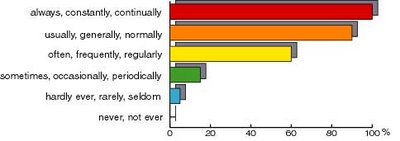
ADVERBS OF FREQUENCY

What are adverbs?

Traditionally an adverb is defined as a word that modifies a verb, adjective, another adverb, or a whole clause or sentence. There are many kinds of adverbs; common types include adverbs of manner that tell how (easily, quietly), adverbs of time that tell when (afterwards, later), adverbs of place and direction that tell where (there, downstairs, backward, up), adverbs of degree that tell how much (very, almost, extremely) and adverbs of frequency that tell how often (always, sometimes, never).

What do we mean by adverbs of frequency?

Adverbs of frequency tell us how often an action takes place.

Where do we put adverbs of frequency?

The basic rule is that adverbs of frequency come before the main verb but after present and past forms of be (am, are, is, was, were). In the case of tenses that use an auxiliary, we put the adverb between the auxiliary and the main verb.

Irregular verbs

As I always tell my students, it is important to know all the irregular verbs by heart. It may sound a little bit difficult at the beginning but there are a lot of fun games and activities on the Internet to help you memorize them. I have selected some games for you to practice.

  • Verbbusters. In this web page you can test your knowledge of irregular verbs and even competing with other users. You can select your level to adjust the questions.
  • The frog verbs game I & II. This exercise is quite entertaining. You have to get the frog across the pond by choosing the right lily for him to jump on to. If you click on the lily with the correct past tense form of the verb, the frog will jump there. If you click on the wrong lily, the lily will sink, and the snake will eat the frog.
  • Go to school. A fun game by Oxford University Press to practice the past simple. You have to read the word in the book, type your answer in the box and press enter. There are 20 words.
  • Go to school II. A fun game by Oxford University Press to practice the past participle. You have to read the word in the book, type your answer in the box and press enter. There are 20 words. Good luck!