
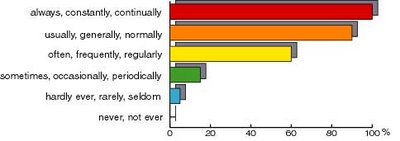
In this unit we will study the most common adverbs of freqüency. The following chart shows the relative frequencies of these adverbs.
What are adverbs?
Traditionally an adverb is defined as a word that modifies a verb, adjective, another adverb, or a whole clause or sentence. There are many kinds of adverbs; common types include adverbs of manner that tell how (easily, quietly), adverbs of time that tell when (afterwards, later), adverbs of place and direction that tell where (there, downstairs, backward, up), adverbs of degree that tell how much (very, almost, extremely) and adverbs of frequency that tell how often (always, sometimes, never).
What do we mean by adverbs of frequency?
Adverbs of frequency tell us how often an action takes place.
Where do we put adverbs of frequency?
The basic rule is that adverbs of frequency come before the main verb but after present and past forms of be (am, are, is, was, were). In the case of tenses that use an auxiliary, we put the adverb between the auxiliary and the main verb.