Next Tuesday, 9th February, we will see a theatre play in English. The name of the play is “Dracula in love”.
You can find more information of the company, the actors and the play in www.bluemangotheatre.com
I hope you enjoy the show!
Next Tuesday, 9th February, we will see a theatre play in English. The name of the play is “Dracula in love”.
You can find more information of the company, the actors and the play in www.bluemangotheatre.com
I hope you enjoy the show!
Next Wednesday the 3rd February we will do the exam of Unit 4. This is the content that you will have to study:
Eat -ate- eaten -menjar
Fall-fell-fallen -caure
Feed -fed-fed – alimentar
Fly -flew-flown -volar
Find -found-found -trobar
In the previous units we studied the present simple in the affirmative and negative forms. In this unit we will study the present simple -questions and short answers.
You can go to the following web pages to continue practising all what we have learnt in class. These exercises are very useful because you will be able to practice the word order of the questions.
This week all the schools and high schools in Esplugues have chosen the best mascot of the Espluday 2010. It was not an easy decision but the winner was…
BOB!!!
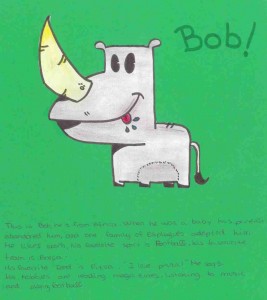
Bob
Bob is from Africa. When he was a baby his parents abandoned him and one family of Esplugues adopted him. He likes sports. His favorite sport is football and his favorite team is Barça. His favorite food is pizza. “I love pizza””, he says. His hobbies are reading magazines, listening to music and playing football.
As a part of the Espluday 2010 activities, we will write a story with the Prat de la Riba school and the Joan Maragall school. We will write the first chapters of the story because we are the older ones. We will start the following week with the Introduction, and the first two chapters.
You will be able to read all the chapters and the story here!

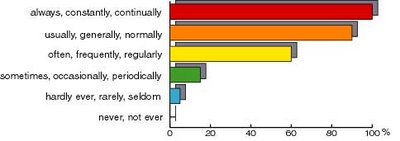
In this unit we will study the most common adverbs of freqüency. The following chart shows the relative frequencies of these adverbs.
What are adverbs?
Traditionally an adverb is defined as a word that modifies a verb, adjective, another adverb, or a whole clause or sentence. There are many kinds of adverbs; common types include adverbs of manner that tell how (easily, quietly), adverbs of time that tell when (afterwards, later), adverbs of place and direction that tell where (there, downstairs, backward, up), adverbs of degree that tell how much (very, almost, extremely) and adverbs of frequency that tell how often (always, sometimes, never).
What do we mean by adverbs of frequency?
Adverbs of frequency tell us how often an action takes place.
Where do we put adverbs of frequency?
The basic rule is that adverbs of frequency come before the main verb but after present and past forms of be (am, are, is, was, were). In the case of tenses that use an auxiliary, we put the adverb between the auxiliary and the main verb.
What do you want to be in the future? In this unit we are going to learn the vocabulary of jobs and professions.

In this unit we will study the vocabulary of the different places in a town and shops.
Below you will find some on-line exercises that you can do at home to reinforce the vocabulary that we have learnt in class and to learn some more. It will be very useful for your next trips abroad!
PLACES IN A TOWN / DIFFERENT SHOPS. Interactive book: common shops and places in town.
PLACES IN A TOWN / DIFFERENT SHOPS. Interactive exercise.
PLACES IN A TOWN / DIFFERENT SHOPS. Interactive exercises. True or false questionnaire.

I wish you all a Happy New Year 2010! May all your dreams come true!
On the 26th of December many English-speaking countries celebrate Boxing Day. This is a tradition that we don’t have in Catalonia and I thought that you would like to learn more about it. Below you will find some interesting facts about this day. Enjoy the reading!
When is it?
December 26th, Boxing Day takes place on December 26th or the following Monday if December 26 falls on a Saturday or Sunday.
Where did it come from?
Boxing Day began in England, in the middle of the nineteenth century, under Queen Victoria. Boxing Day, also known as St. Stephen’s Day, was a way for the upper class to give gifts of cash, or other goods, to those of the lower classes.
Where is Boxing Day celebrated?
Boxing Day is celebrated in Australia, Britain, New Zealand, and Canada.
How is Boxing Day celebrated?
There seems to be two theories on the origin of Boxing Day and why it is celebrated. The first is that centuries ago, on the day after Christmas, members of the merchant class would give boxes containing food and fruit, clothing, and/or money to trades people and servants. The gifts were an expression of gratitude much like when people receive bonuses, from their employer, for a job well done, today. These gifts, given in boxes, gave the holiday it’s name, “Boxing Day”.
The second thought is that Boxing Day comes from the tradition of opening the alms boxes placed in churches over the Christmas season. The contents thereof which were distributed amongst the poor, by the clergy, the day after Christmas.
Today, Boxing Day is spent with family and friends with lots of food and sharing of friendship and love. Government buildings and small businesses are closed but the malls are open and filled with people exchanging gifts or buying reduced priced Christmas gifts, cards, and decorations.
To keep the tradition of Boxing Day alive, many businesses, organizations, and families donate their time, services, and money to aid Food Banks and provide gifts for the poor, or they may choose to help an individual family that is in need.
What a great extension of the Christmas holiday spirit. You might consider making this holiday a tradition in your family. No matter where you live the simple principle of giving to others less fortunate than yourself can be put into practice.
Today is Christmas Day and I would like to take this opportunity to wish you all a… MERRY CHRISTMAS! Below you will find a link to a famous Christmas carol. I hope you enjoy it!
All I want for Christmas is you. Click here to find the lyrics.