A mag created with Madmagz.
Hello,
Here you can listen to an introduction about our blog.
Arxiu enregistrat amb l’App Spreaker Studio i editat amb Audacity
Have you ever seen any film about cooking?If the answer is YES, please write a report in our blog telling us something about the film and we will answer you!
Arxiu enregistrat i editat amb l’Audacity
See you soon.
How to roast a turkey
Preheat the oven to 180C/160C Fan/Gas 4. Check that you have not left the plastic bag of giblets lurking inside the bird. Put the turkey in a large, deep roasting tin. Season generously all over with salt and pepper and massage the seasoning into the skin.
Melt the butter in a large saucepan. Fold the muslin in four and lower it into the melted butter, pushing it in so that it soaks up virtually all the butter.
Lift out the butter-soaked muslin and lay it over the turkey, making sure that it completely covers the breast and upper thighs.
Pour about 300ml/½ pint water into the roasting tin and slide it into the oven. Cook for approximately 3 hours 20 minutes, basting the bird approximately every 30 minutes with the pan juices.
Test that the turkey is properly cooked in just the same way as you would a chicken. Pierce the thickest part of the thigh with a skewer. If the juices run clear then the turkey is done. If they are pink, slide it straight back into the oven for a further 15 minutes before testing again and continue to do this until they do run clear.
Once it’s done, transfer the turkey to a large serving dish, discard the muslin and leave in a warm place to rest for at least half an hour. Cover with foil to stop the meat going cold.
While the turkey is cooking, make the bread sauce. Pour the milk into a heavy-based saucepan. Stick the four cloves into the onion, add to the milk and bring very, very slowly up to the boil, so that the milk has plenty of time to absorb the flavours of the onion and the cloves.
Remove the onion and cloves and stir enough breadcrumbs into the milk to give a thick sauce. Season to taste with nutmeg and salt. Stir in the butter or cream, adjust the seasoning, then spoon into a warm serving bowl, sprinkle with a little cayenne pepper and place on the table. If making in advance, leave to cool, then cover with cling film and store in the fridge for up to three days. Reheat thoroughly before serving. Sprinkle with the cayenne pepper just before serving.
Pre heat the oven to 180C/350F/Gas 4.
Mix the flour and sugar together in a bowl, then rub in the butter with your fingertips until the mixture resembles fine breadcrumbs.
Add the egg and vanilla essence and mix to form a soft dough.
Roll out onto a well-floured work surface and cut into rounds. Place on greased baking sheets and bake for 10-12 minutes, or until golden brown.
Cool on a wire rack. When completely cool decorate.
Roll out the white fondant icing and cut out circles the same size as the biscuits, brush the backs of the circles with a little cooled boiled water and stick them to the biscuits, smoothing down the icing as you stick it on.
Roll out the blue icing and cut out more circles, then cut these in half and using a little more water and stick on top of the white icing for the hats.
Brush the hats with water in places where you want the sprinkles to stick and then sprinkle!
Pipe decorations on the hat with the white writing icing, then pipe a small blob for the hat bobble and another for the nose – stick on the chocolate balls. Pipe black eyes and mouth then leave to set.
Els alumnes de sisè han començat a elaborar les seves receptes i ja es comencen a veure algunes imatges de les grans elaboracions d’aquestes magnífics cuiners i cuineres!
Durant la creació de les receptes a l’aula, l’escola ha intentat que els alumnes pensessin en aquells plats que formessin part d’una alimentació saludable i en molts casos així ha estat el resultat. La tendència que hi ha és a l’elaboració d’un plat fàcil ja que és el més senzill d’explicar en una recepta si l’han de fer ells mateixos amb l’ajuda de la família.
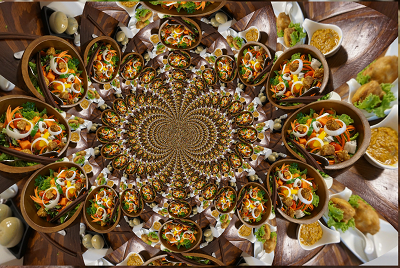
La foto que hem decidit editar és una de les receptes que ha elaborat un alumne de sisè amb la seva família. Esperem que us agradi!
Aquest és el resultat de la meva edició de la foto amb el programa Pixlr. EL filtre que he utilitzat es diu ‘calidoscopi’.
Actualment, l’ús didàctic del material multimèdia és molt important dins les nostres aules. Cada dia es desenvolupen activitats a l’aula on la utilització d’aquest tipus de material juga un paper molt important tan pel mestre com per l’alumne.
Pel que fa als mestres, és més el ventall de possibilitats que tenim a l’hora de presentar la informació als nostres alumnes i d’alguna manera fer-la molt més atractiva i engrescadora per ells. Hi ha moltes activitats que segurament anys enrere no es podien fer ja que els materials dels que disposava el mestre no eren els que tenim ara, i això considero que s’ha d’aprofitar i no caure en la monotonia de la típica classe de sempre.
Pel que fa als alumnes, actualment, es parla molt de l’adquisició de la competència digital en el dia a dia a l’aula. Si que es veritat que la recerca d’informació, la planificació o la organització de la feina és molt més ràpida i efectiva però s’ha de tenir en compte la manera en què es presenta aquesta competència a l’alumne. La lliure utilització d’aquesta competència pot portar als mestres a observar quins són aquells alumnes que en fan un bon ús i quins no i d’aquesta manera veure molt ràpidament els resultats obtinguts.