project meetings
First Project Meeting
Zabrze (Poland), 21st-24th October 2009
As the partner schools had not met before, this first meeting was the occasion to introduce ourselves and the schools we represent: teachers joining the project from each school, characteristics of each institution, type of students, surroundings and population, especial units (for ex.: units for pupils with learning difficulties, units for new students, etc.).
We had the opportunity to get to know a bit more about the characteristics of the Polish Educational system through our Polish partner school. We visited the city of Zabrze and its interesting sides, and we took part in an educational activity around the traditional process of making bread.
We agreed the calendar of the following meetings. The common activities of the project were redefined and some of them were added to the initial programme (the survey about the eating habits or the European Christmas meal).
We established and prepared the plan to start the exchange programme.
Each country presented the activities that were going to take place in their institution:
HUNGARY
- Making a web quizz about traditional own cuisine to be answered by the other countries.
- Questionnaire about eating habits. The questionnaire will be answered by around 90 students between 14-15 years old (3ESO). The results will be studied and compared by all countries.
- Working around religion and food in the arts.
- Recipes connected to traditions: We agree to exchanging traditional recipes from each country:
Entrée (France)
Soupe (Spain)
Main course (Poland)
Dessert (Hungary)
- Producing a glossary (second year of the project).
SPAIN
- Creation of the Comenius blog “FOOD FOR THOUGHT”.
- Study and compare the eating habits among the different countries through the results of the questionnaire.
- Working about healthy lifestyle and discuss about nutrition.
- In the cooking class (coached by an English teacher), present national plates and elaborate dishes of the other countries participating in the project.
- Students coming from other countries will contribute with their own recipes.
- Learning food proverbs and finding their equivalences in English.
- Working around the production process of the olive oil.
- Gastronomy and Literature: Collecting materials for the Multilinguistic gastronomy glossary.
- Learning about eating habits of the classics. Cooking a classical recipe.
- Studying paintings related to food.
POLAND
- Questionnaire about nutritional habits (already done).
- Working on the connection between history and gastronomy.
- Write essays for the cookery book.
- Grastronomy & Geography.
- Religion and cooking. Working on a religion calendar.
FRANCE
- Creation of a forum to keep a better communication between participants and in order to exchange information about the project:: http://gastrad.forumactif.com
- Production of an interactive map.
- With the students of the special unit:
– Bread production: Test different types of bread and find the cereal.
– Tea time (English)
– Plastic menu (Arts)
– Lorraine menu
- Writing little stories around “ginger bread”.
- Working around Gargantua (giant, symbol of life).
- Art productions around Arcimboldo.
- Prepare a healthy meal (typical from Lorraine)
- Drama club: work with pieces connected with gastronomy.
 |
 |
 |
 |
 |
 |
 |
 |
 |
 |
Second Project Meeting
Ajka (Hungary), 18th-23rd May 2010
The opportunity of living for a few days with an Hungarian family was the best way for the students to get to know the culture, the Hungarian traditions, the people and the country. They had the chance to practise and improve their English with their partners and this was such a great experience that they will always remember.
We visited the factory of the world-famous Ajka Crystal, we met the local media and spent the last day visiting the beautiful city of Budapest all together.
During the meeting the students worked on the project and found the answers to the web quizzes about the gastronomy and traditions of the other countries. The results of the survey about the eating habits of the young people in Europe were compared and commented.
The following agreements were achieved about the activities to be done for the following meeting in Barcelona:
1. Creating a piece of art with the remains of food: 10 pieces of art per team with an English title. Photos of the pieces of art in size A4. The works will be exposed in Barcelona and the best one will be chosen by the students.
2. Creation of a glossary to be included in the final cookery book: Students of each team will have to choose 10 words connected with food culture (dishes, food, drinks, etc.) and write the definitions.
3. Presentation of own stereotypes (in a funny way) connected to food culture or eating habits. Discussion around the stereotypes.
4. Agreements about the composition and the form of the final Cookery book.
Third Project Meeting
Hospitalet de Llobregat, 16th-21st November 2010
During the third meeting the exposition “FoodArt” took place. Pieces of art made with the remains of food were exhibited and the students chose the best one of each team. The best ones will be on the cover of the final Comenius Cookbook.
The tapas workshop was a success and students from different nationalities worked together in the kitchen to prepare the tapas that we ate afterwards. They were delicious!
The sketches about own stereotypes or eating habits were performed.
The last day we had a farewell dinner with the students, teachers and the hosting families.
The final form of the Comenius book was agreed during the meeting.
Apart from the project work we also had time to show to our hosts some of the most interesting sites in Barcelona: the Sagrada Familia, Parc Güell, the Ramblas, etc. We did a workshop about traditional Catalan instruments and visited the Cavas Codorniu and Montserrat.
Last Project Meeting
Saint Dié-des-Voges, 17th – 21st May 2011
This was another fantastic experience for the students travelling to France.
During the final meeting, the Comenius Cookery book was compiled and was presented officially together with the results of the project.
We could also attend a drama representation by the French students.
On the last day of the meeting, all the students prepared some tapas that were served on the official reception of the last day.
We spent the last day visiting Paris.
Poland: www.gimnazjum21.cp.win.pl
Hungary: www.fekete-vorosmarty.hu
http://comeniusgastronomy.blogspot.com
Spain: santa eulalia bloc
France: French newspaper
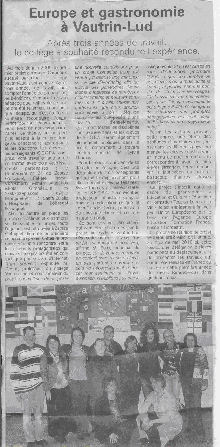
The Comenius Project in a French Newspaper Vosges Matin 24.10.2009
Europe et gastronomie à Vautrin-Lud
Après trois années de travail, le collège a souhaité reconduire l’expérience.
Au mois de juin 2009, le premier projet européen Comenius auquel participait le collège Vautrin-Lud s’est achevé. Après trois années de travail, sans compter l’année de préparation, les bénéfices, d’un point de vue pédagogique, retirés de ce projet ont été tellement importants que l’équipe, qui s’est étoffée, a souhaité reconduire l’expérience pour les deux années à venir avec de nouveaux partenaires. Le thème, on ne peut plus adapté à la culture française, concern la gastronomie et les traditions. Les élèves et les enseignants (S.E.G.P.A. comprise) vont travailler autour de ce thème avec trois établissements partenaires: le Gimnazjum nr 21 de Zabrze (Pologne), Fekete István-Vörosmarty Mihaly altalanos Iskola, Gimnázium és Szakközépiskola d’Ajka (Hongrie) et l’I.E.S. Santa Eulàlia de l’Hospitalet de Llobregat (Espagne).
Afin de mettre en place les premières actions et d’harmoniser l’ensemble du projet, toute l’équipe s’est retrouvée à Zabrze (Pologne), lieu de la première réunion de projet. C’était la première véritable rencontre entre les différents protagonistes qui n’avaient jusqu’alors été en contact que par le biais d’Internet. “L’an dernier, explique M. Dedun, professeur au collège Vautrin-Lud et coordonateur du projet, quand l’idée de proposer une nouvelle candidature pour un projet Comenius nous est venue, j’ai déposé une annonce sur le site d’e-twinning afin de trover des partenaires. Notre thême a intéressé de nombreux établissements et nous en sommes ravis. Il a fallu choisir nos partenaires que nous souhaitions limiter à trois.” L’équipe française est composée d’une dizaine d’enseignants. Qausiment toutés les disciplines sont représentées et les élèves de S.E.G.P.A. seront également pleinement impliqués dans le projet, notamment à travers l’atelier cuisine de Sylvie Thomas.
Pour la réunion qui vient de se dérouler en Pologne, c’est une délégation de trois enseignants qui a fait le déplacement pour aller rencontrer les partenaires: Syilvie Thomas, professeur d’atelier en S.E.G.P.A., Alain Montier, professeur d’histoire-géographie et d’éducationa civique et Jean-Claude Dedun, professeur de physique-chimie et coordonateur du projet.
Ce sont environ 150 élèves qui vont être concernés par le projet au college Vautrin-Lud dès cette année scolaire. “Ce projet est important pour eux, affirme M. Boux, principal du collège, car ils vont se retrouver en contact avec d’autres élèves un peu partout en Europe et cela va nécessairement renforcer leur sentiment de citoyen européen. N’oublions pas que le Collège Vautrin-Lud est classé en zone d’éducation prioritaire (Z.E.P.) et que bon nombre de nos élèves n’ont jamais quitté la France, ni parfois même le bassin de Saint-Dié-des-Vosges. Cést aussi extrêmement intéressant por l’équipe enseignante qui a la possibilité d’échanger et de découvrir des pratiques pédagogiques qui sont appliquées dans d’autres pays que le notre.”
Parmi les actions prévues cette année, une étude des habitudes alimentaires des jeunes dans les différents pays sera menée, les élèves constitueront un menu de noël européen, ils correspondront aven certains élèves étrangers, feront découvrir la fabrication du pain et beaucoup d’autres choses encore.
Ce projet s’inscrit dans le cadre du programme «Education et Culture: Educationa et Formation Tout au Long de la Vie» et est entièrement financé par l’Union Européenne par le biais de l’Agence Europe Education Formation France, basée à Bordeaux.
La prochaine réunion de projet se déroulera à Ajka, en Hongrie, au mois de mai 2010 et, cette fois-ci, une délégation d’élèves participera au déplacement afin de présenter les travaux qui auront été réalisés en France au cours de cette première année de travail. Rendez-vous dans quelques mois.