other recipes
CHRISTMAS
Although Christmas has lately evolved into a more commercial concept, it has always been a period of time to be at hom with the familiy.
Catalan Christmas has its own characteristics. One example is the realization of the “pessebre”, a representation of the nativity of Jesus built with moss, logs, cork and clay figures that represent characters of rural life.
Another example is the “Tió de Nadal”, which is a trunk decorated with legs, a smiling face and a typical catalan beret. It is also simply called “Tió” and it’s fed and covered with a blanked by the children of the house for several days before Christmas. On the afternoon or the night before Christmas day the “Tió” is hit repeatedly with a stick by the children while they sing a traditional song. Then the “Tió” shits candies, simple toys or things to eat and drink for the meals of the following days.
Another peculiarity of Catalan Christmas is the celebration of St. Stephen’s Day, Boxing Day, in order to meet the other part of the family who could not be there for Christmas. On this special day the kids say a verse and they are given some money by the parents.
It is also very typical in many villages of Catalonia to go and see “Els Pastorets” (“The Shepherds”), a theatrical performance focusing on the advent of Jesus.
The typical menu of Catalan culture on Christmas Day is the “Catalan Hotpot” for the first course. The second course, according to tradition is usually meat. The most common is either baked chicken or stuffed.
This meal is usually served with cava or red wine. Nougats and wafers are served as a dessert.
(Catalan Hotpot recipe to be checked under “Recipes”)
EASTER
In a country of Catholic tradition such as Spain, Easter week is the busiest time of the liturgical year. Although there are many differences from one region to another, Easter is mainly celebrated in the street with demonstrations of faith, called processions. These processions often include religious images of the Passion of Christ or images of Mary. Penitents taking part in them wear the typical conical hats and robes matching the same colour of their Holy Brotherhood.
Regarding the gastronomy, the austerity of Easter cuisine is totally opposed to the abundance shown in the Carnival, and this is one of its main features. Fish accompanied by all kinds of vegetables and legumes are the most popular dishes.
In Catalonia, it’s customary for godfathers to give “Mones de Pasqua” to their godsons on Easter Sunday. The “Mona” initially was a dough of cake made with sugar and other goodies, with hard-boiled eggs on top. Later, these eggs turned into chocolate eggs and nowadays the “Mona” is wholy made of chocolate.
The Easter fritters are usually made at home and traditionally were eaten on Good Friday.
BUNYOLS DE QUARESMA- Easter Fritters
Ingredients:
anisette 125 ml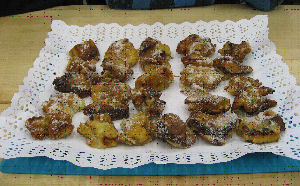
milk 125 ml
butter 125 gr.
flour 150 gr.
eggs 6
baking powder 16 gr.
a pinch of salt
a pinch of cumin
oil
Preparation:
Pour the anisette and the milk into a casserole. Add the butter and stir continuously until the butter is melted. Bring it to the boil. Add the flour and stir constantly with a wooden spoon until you get a soft dough and everything is thoroughly mixed. Remove from the heat.
Stir in the eggs into the mixture, one at a time. Use a rotary beater. Once the eggs are beaten, add the baking powder and put it aside.
Heat the oil gently in a frying pan. Once the oil is hot put the fritters into the frying pan, one at a time. Use a wooden spoon. Fry until golden. Remove them from the frying pan with a slotted spoon. Drain on absorbent kitchen paper and keep hot while the remaining fritters are cooked. Sprinkle with sugar.
They can be eaten either cold or hot.
Advice:
Fritters are a Lent speciality traditionally eaten on Good Friday though nowadays can be eaten the whole period of Lent.
Recommended wine: mistela (a sweet wine)
TRADITIONAL DISHES
All Saints (Omnia Sanctorum) is a festivity dedicated to the memory of ancestors which is celebrated on November 1st. It is the tradition to celebrate mass in honor of the dead and then go to the cemetery to bring them flowers.
The especial meals of this day are: roasted chestnuts, sweet potatoes and a type of small cakes called “panellets”. There many different kinds of “panellets”: coconut, chocolate, almond, pine nut, coffee, etc.
Roasted chestnuts are sold on the streets by the chestnuts’ sellers who used to be dressed in a traditional way: they had a very wide sargil skirt with a woolen and hempen apron.
PANELLETS- Pine nut and marzipan balls
Ingredients:
500 gr of grated almonds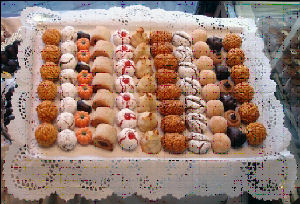
500 gr of sugar
600 gr of potatoes
2 eggs
pine nuts
a pinch of flour
grated lemon peel
Preparation:
Boil the potatoes and mash them. Mix together the grated almond, sugar and grated lemon peel until a smooth marzipan paste is obtained. Add the mashed potatoes and make a smoooth dough. Arrange the pine nuts on a plate. Beat the eggs lightly and mix them with the pine nuts. With the marzipan paste make balls and then place them on the pine nuts so that they stick to them. With the hands full of pine nuts round out the balls, covering them well with the pine nuts. These balls are then placed on an oven-proof dish sprinkled with flour and brushed over with the beaten egg. Then place them for 5 minutes in the oven at 300o C.
Advice:
“Panellets” can be made in several flavours by adding lemon juice, or other flavourings, covering them with almond flour and icing sugar instead of pine nuts. You can even use crystallized cherries and quince jelly. A sweet wine is recommended to go with it.
Recomended wine: mistela (a sweet wine)
ETNIC-REGIONAL
In the last years Catalonia has welcomed a great deal of immigrants from different countries. An important stream comes from South America. It is easier for them because we share the same language. The gastronymy is a mixture between ethnic dishes and colonial contributions. There’s a great variety of dishes which are quite similar to Sanish ones such as “empanada gallega” and “empanada argentina”, different cakes, sweets and desserts.
COCONOUT AND MILK SWEET
INGREDIENTS:
1 coconut 
500 g of sugar
1/2 l of milk
Cinnamon stick
Vanilla essence
PREPARATION:
- Break open the shell of coconut.
- Remove the skin of coconut.
- Grate the coconut.
- Pour the milk and the grated coconut into a saucepan.
- Stir the milk and coconut while adding the sugar and cinnamon.
- Cook over a low heat, stirring constantly and leave the milk boil down.
- Add vanilla essence and stir for 5 minutes. Transfer to a serving dish.
ADVICE:
Eat it cold
ESPECIAL EVENTS
St. John’s Eve, June 23rd, , is a very ancient festival which celebrates the arrival of the summer solstice in the northern hemisphere, though the shortest day of the year is on 21st. The main rite is to burn a fire. The purpose of this ordinance was to give the Sun more power as it was becoming weaker – the days are getting shorter until the winter solstice. Symbolically, the fire has also the function of purifying the people who are watching it.
In Catalonia we celebrate the “Verbena de St. Joan” also known as “The night of Fire” on the night of 23rd to 24th of June. Traditionally, bonfires were prepared with furniture and junks on the previous days and children used to put a “ninot” or doll on top. When the sun is setting the bonfire is lit with torches and the party begins. We have dinner outdoors with family and friends and each village or neighborhood has its own band with life music.
The traditional dessert of this day is the “Coca de St. Joan”, of which there are sweet and savory variations. The base is similar to the brioche and it is covered with cream, candied fruit or pork rinds. In a source the “coques” had a circular shape, symbolizing the sun. The typical drink of he night is cava.
COCA DE SANT JOAN
Ingredients:
a glass of milk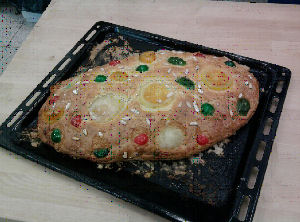
2 spoonfuls of sugar
50 g butter
half a spoon salt
350 g flour
30 g baking powder
50 g pine nuts
1 lemon
a pinch of ground anisette
2 eggs
60 g sugar glass
candied fruit
a pinch of cinnamon
Preparation:
Sift the flour and round it off. Make a hole in the middle and stir in the sugar, milk, 1 egg, cinnamon, the grated peel of the lemon, salt, ground anisette and baking powder.
Melt the butter. Leave it to cool.
Sprinkle the surface of the table with flour, stir in the butter with all the ingredients until the dough is soft and elastic. Knead it into oval shape. Leave it to rise for an hour.
Beat the other egg and brush the surface of the dough. Top it with bits of candied fruit and pine nuts. Sprinkle with sugar glass
Pre-heat the oven to 180 º C. Bake it from 25-30 minutes until golden brown.
Advice:
Every year on 23rd June at night people eat coca and drink cava to celebrate the summer solstice.
CATO’S CHEESECAKE (LATIN DEPARTMENT)
INGREDIENTS:
Half a cup of plain floor
One cup of ricotta cheese
1 egg beaten
6 bay leaves
PREPARATION
Sift the flour in a bowl.
Beat the cheese until soft, stir into the flour.
Add the beaten egg to the flour/ cheese mixture, making as soft dough.
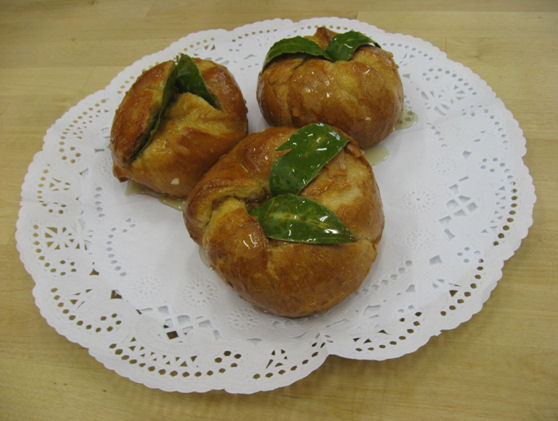
Divide the dough into three parts and shape them into buns.
Put two fresh bay leaves onto each bun.
Place the buns on a baking tray.
Heat the oven to 220 C. Bake for 40 minutes until golden brown.
Warm the honey.
Sprinkle the buns with the honey and wait until the honey is absorbed.