New York Rock
The True Colors Tour at Radio City Music Hall, New York, NY, June 18, 2007
Cyndi Lauper (a.k.a. my childhood idol) founded the True Colors Tour in support of gay and lesbian rights. The show was advertised as five hours of music, but yours truly doesn’t have the butt muscles to sit for longer than two, so I showed up at 9 PM only to learn Debbie Harry had just finished her set. Shit. I also missed Amanda Lepore and Cazwell, the Gossip, and the Dresden Dolls. But I did manage to see Rosie O’Donnell do some stand-up. “Where are my gays?!” she screamed to a hall full of mostly gays. “I just spent the last nine years with heterosexual women,” she said, referring to her time on The View.
____________________________________
New York Kincks
Pavilions
Madison Square Garden (1946-present)
History
The Knicks is one of two teams who attended the NBA start, and still remains in the same city (the other being Boston Celtics).
Early
The first game of the Knicks (and the BAA) was contested on November 1, 1946 against the Toronto Huskies at Maple Leaf Gardens, where the Knicks won 68-66. In the early years were consistent in reaching the playoffs, thanks to players like brothers Alec and Eric Taitz. During the first decade of existence in the NBA, the Knicks reached the finals in three consecutive years (1951-53). The remainder of the 1950s, the Knicks have a decent if not great teams and reach the playoffs in 1955, 1956 (lost in a playoff game played with a single Syracuse Nationals), and 1959.
  |
_______________________________________________________________
Statue of Liberty
– Officially titled “Liberty Lighting the World”, the statue was a gift from France commemorating liberty and friendship with the United States of America.
– The statue is supported inside by an innovative metal framework designed by Gustave Eiffel, the designer of the Tour Eiffel.
– The statue welcomes visitors and immigrants arriving in New York by boat, many of them crossing the Atlantic and seeing America for the first time.
– The seven spikes on the crown represent the seven continents and seven seas of the world. – The climb from the ground to the tower’s crown is 354 steps.
– The base is 65 feet tall, the pedestal is 89 feet tall, and the statue itself is 151 feet and one inch to the tip of the torch.
– Some of the statue’s proportions: her right arm is 42 feet long; the nose measures 4.5 feet to the tip; the mouth is 3 feet wide; and her index finger is 3 feet long.
The mausoleum of Ulysses S. Grant, this building exemplifies the presence of social institutions and high culture in Morningside Heights. It also reflects the panthesitic experimentation of the period immediately following the Civil War. Financed by public contributions, the marble building is rendered in an eclectic classical style reminiscent of the Pantheon. Inside, it houses the black granite sarcophagi of Mr. and Mrs. Grant. Undulating mosaic benches by Pedro Silva and the City Arts Workshop [1973] surrounding the tomb were are a community project intended to beautify the site.
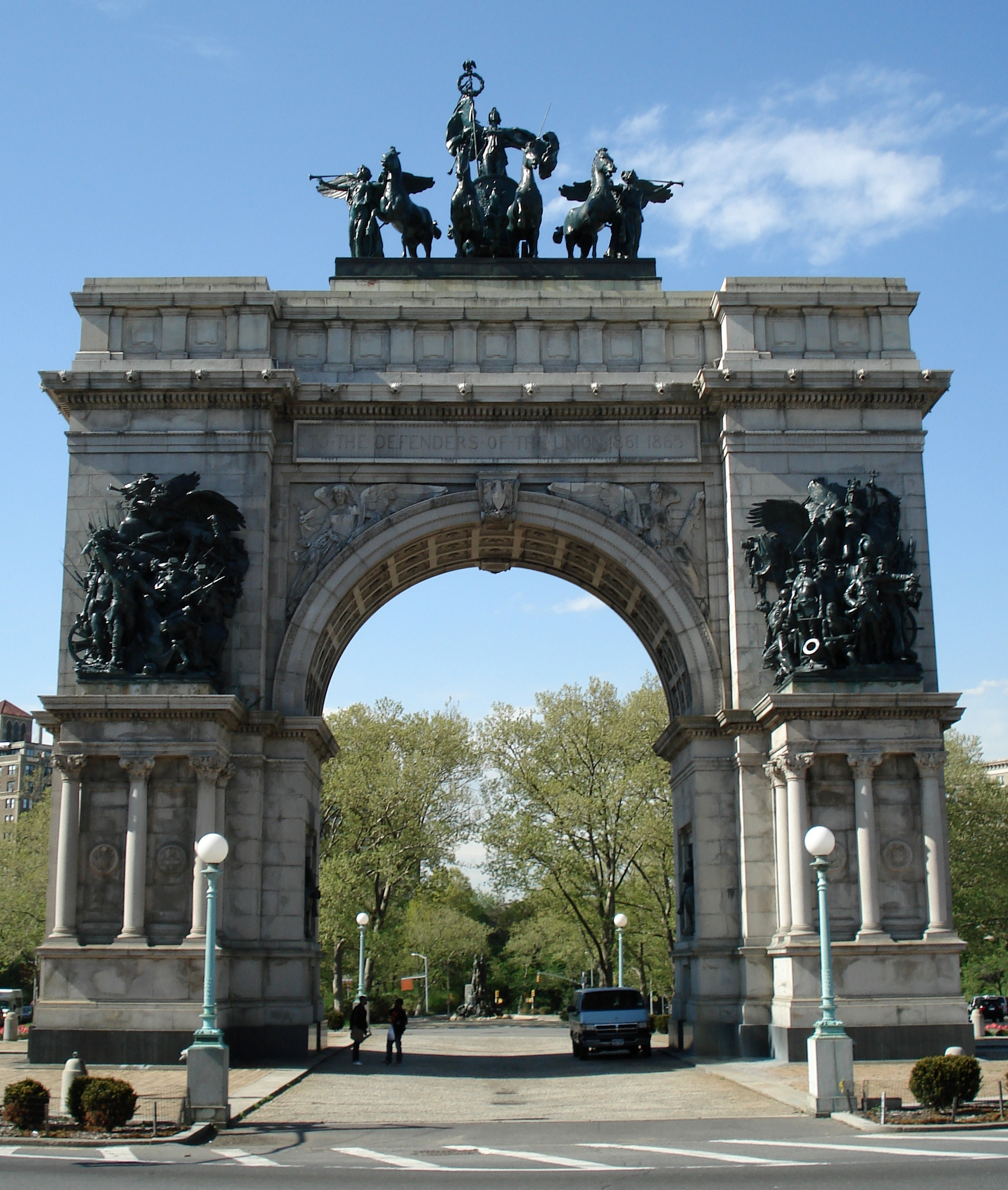
Olmsted & Vaux designed this monumental oval traffic circle in the spirit of Paris’ Etoile (now the Place Charles de Gaulle), that circular 12-spoked traffic rond point that bears in its central island the Arc de Triomphe, although they opposed an arch here. A masterstroke of city planning, this nexus joins their great Eastern Parkway, and their Prospect Park, with the avenues that preceded it on other geometries. This triumphal arch did not arrive for 22 years: the Soldiers’ and Sailors’ Memorial Arch W by John H. Duncan, architect of Grant’s Tomb, was built between 1889 and 1892, commemorating Union forces that perished in the Civil War. The arch provided, as in its Parisian inspiration, an excellent armature for sculpture, planned by Stanford White (McKim, Mead & White. 1894-1901), the most spectacular of which is Frederick MacMonnies’ huge quadriga on top (1898). Inside the arch itself is more subtle work, bas-reliefs of Lincoln (Thomas Eakins) and Grant (William O’Donovan), both installed in 1895. On the south pedestals are two bristling groups representing The Army and The Navy by MacMonnies (1901). A museum within the arch is open to the public.
   |