in this unit we learn:
– personal pronouns
– verb to be
– countries and nationalities
-reading: international friends
– basic adjectives
– writing an email
in this unit we learn:
– personal pronouns
– verb to be
– countries and nationalities
-reading: international friends
– basic adjectives
– writing an email
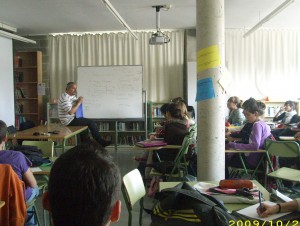 Last tuesday, we had a very special surprise. A “live” listening activity!. The Australian writer Carlo Vella came to our school and gave us an interesting lecture about his country. Students at 2nd batxillerat could hear and speak to him about many topics related to the continent. We all learnt about aboriginies and yobbos, kangaroos and dingoes, deserts and houses under the sand, Chinese immigrants and European newcommers… A great and enjoyable experience.
On behalf of all our students and teachers at IES Guinovarda, we would like to thank Carlo so much for his effort and his unvaluable help. It has been a one-in-a-lifetime opportunity to have a native English speaker in our class.
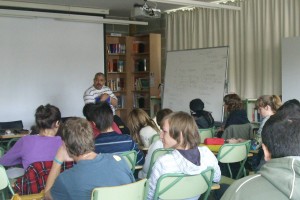 If you are interested in knowing more about Carlo’s biography or books you can click here and visit his website.
 In this unit we learn:
– place prepositions (next to, in , behind…)
– there is / there are
– some / any
– have got
– city vocabulary ( post office, park, sports centre…) and shops ( shoe shop, supermarket…)
– texts from pages 15 and 20 (reading, dictation and translation)
– write about a city
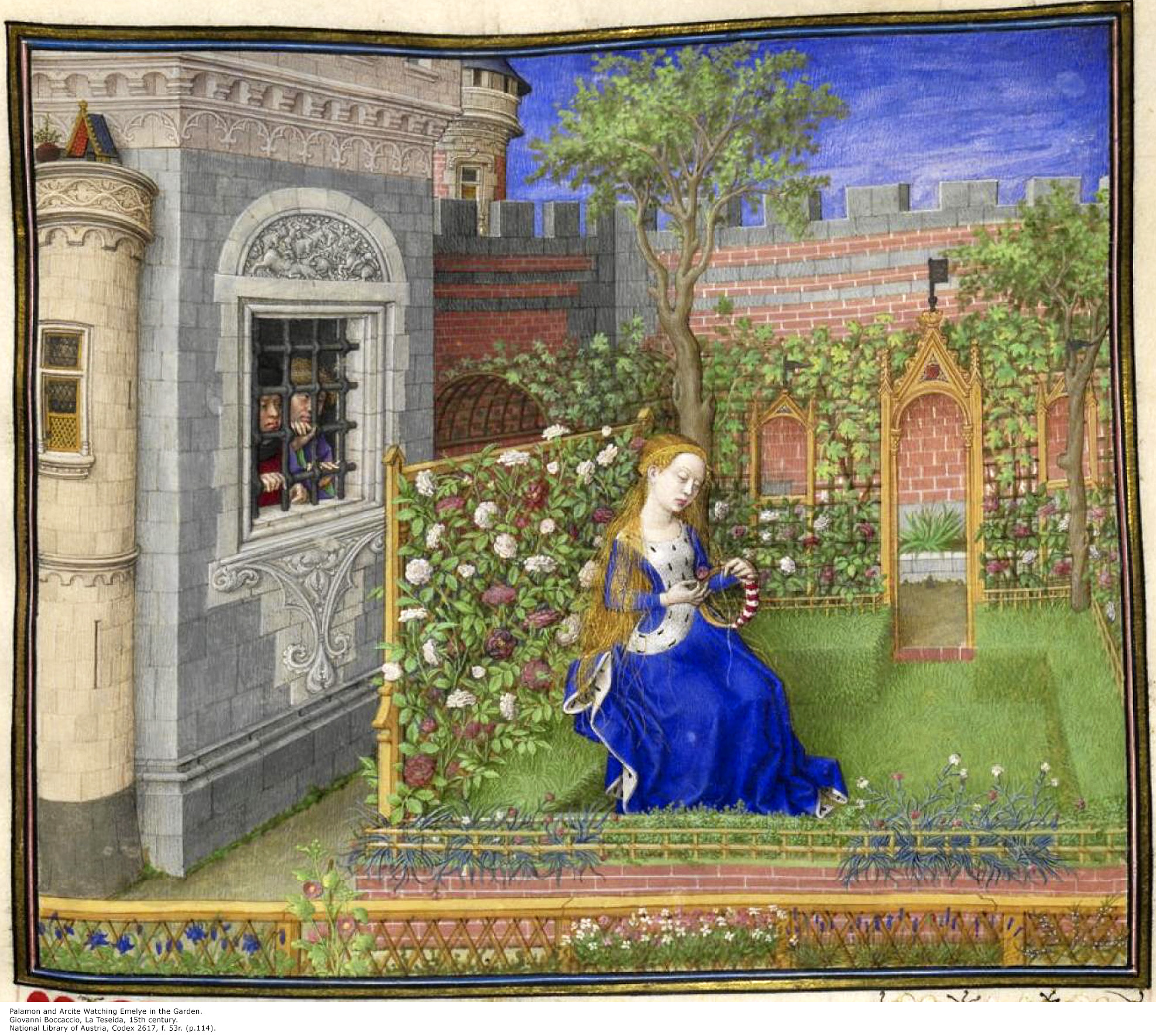
Palamon, Arcite and Emily are the main characters of this epic tale told by the knight. Epic stories usually have heroes and warriors, princess and gods who are faced with very difficult situations and big dilemmas. Heroes must choose between love and friendship, honor and family, treason or happiness. Sometimes they are a model to follow, sometimes they are not. But they are always very special.
If you are want to see more images based on the story, click on this interesting link luminarium
If you have information to share with your peers, post your ideas, please.
Jules Verne is the writer of our novel “Around the world in 80 days”.
What do you know about him?
Surf in the net and find some information about him. Post your comments.
Here you have some ideas:
Where is he from?
What was his job?
Was he married?
Did he write anything else?
You cannot repeat information that is already on the blog, so check before posting!
In this unit we have learnt:
– personal pronouns (I, you, he…)
– possessive adjectives (my, your, his…)
– verb to be (am, are, is…)
– question words (how, what, when…)
– countries and nationalities
– basic adjectives (quiet, noisy, interesting…)
– reading: international friends, hanna montana…
– writing: an email

This is the book we are reading this year. Remember you need it in november.
Around the world in 80 days
Jules Verne
Dominoes starter / Oxford university press

Tria un país i envia un comentari amb les dades d’interès que hagis trobat i escrit a la fitxa. Recorda que cal incloure el nom del país, la capital, el nombre d’habitants etc…
Si vols informació sobre països, pots consultar una enciclopèdia on line: la viquipèdia. Aquí tens els enllaços a la versió catalana i a la versió anglesa.

Chaucer introduces a long list of pilgrims who will be travelling to Canterbury together from London. Very different people will share days and nights and stories, as they decide to avoid boredom explaining tales. All kind of men and women, rich and poor, good and bad, literate and analphabet, from the city and the countryside, religious and warriors, merchants and peasants… a wide range of representatives from medieval society come to meet us in one of the most important texts of English literature.