Our Food’s Journey
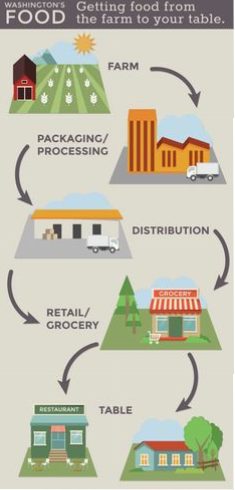
Food often travels thousands of miles from where it is produced to where it is sold and eaten. Students will learn why food is transported long distances and consider the advantages and disadvantages. Students will critically examine and debate different scalesof food distribution (local, regional, national, and global).

A Supply Chain
What is a supply chain?

-
1. Introduce the concept of a supply chain.
Explain to students that a supply chain is a network of people and activities that help move a product from start to consumption by the end user. Encourage students to think about how the complexity of a supply chain might vary for different types of products; for example, produce that is sold at a farmers market versus a CD that is sold at a store.2. Explore a real-world example.
Ask students to help identify the various materials needed to make a candy bar. Write the ingredients on the board as individual students think of them. Ask students to pinpoint on a wall map of the world where the materials come from. They can use a print or online encyclopedia, as needed. Use the following list as a guide:- Cocoa—West Africa, Central and South America, and parts of Asia
- Nuts—worldwide, depending on the type of nut
- Aluminum Foil (for wrapper)—West Indies, North America, and Australia
- Sugar—Brazil (primarily), India, and China
- Paper (for wrapper)—North America
- Raisins—California, Turkey, Chile
- Milk—United States
- Corn Syrup—United States, Europe, Brazil, and Mexico
- Vanilla—Madagascar, Indonesia, China, and Mexico
3. Have pairs of students sketch the supply chain.
Divide students into pairs and provide them with drawing paper. Have pairs of students sketch out a supply chain process for a candy bar, using the list of materials the class brainstormed.4. Have pairs of students explain their work.
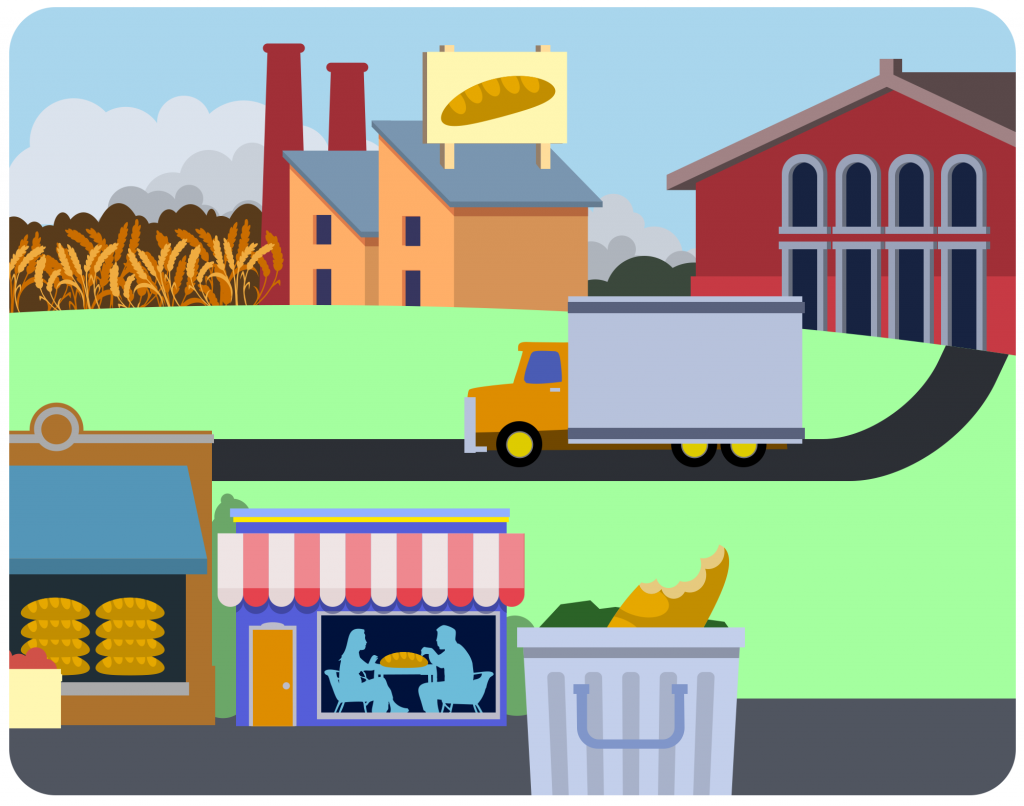
Ask each pair to briefly present their drawing and explain their thinking to the class. Highlight the key supply chain stages by writing them on the board as students say them and drawing arrows between them. Key stages include:- Supply—raw materials supplied to manufacturing
- Manufacturing—focuses on building, assembling, converting, or furnishing these raw materials into finished products
- Distribution—focuses on ensuring these products reach consumers through an organized network of transporters, warehouses, and retailers
- Consumption—customers
5. Revisit the discussion from Step 1 about complexity.
Point out to students that the diagram you drew is an example of a very simple supply chain for a single product, where raw material is acquired from suppliers, transformed into finished goods in a single step, and then transported to distribution centers, and ultimately, customers. Explain that a typical supply chain is likely to be much more complex, involving many interchanges among the different stages and players. Remind students of the example of produce versus a CD. Ask them to sketch a more complex supply chain to make sure they understand the concept.Extending the Learning
If possible, have students visit the Illicit website or watch the National Geographic film Illicit: The Dark Trade. An excerpt of the film is provided in this activity. Go to the PBS website to find out where you can get the full DVD.
lesson7-foods-journey-lessonplanlesson7-foods-journey-slides