Unit 3. Growing the food we need
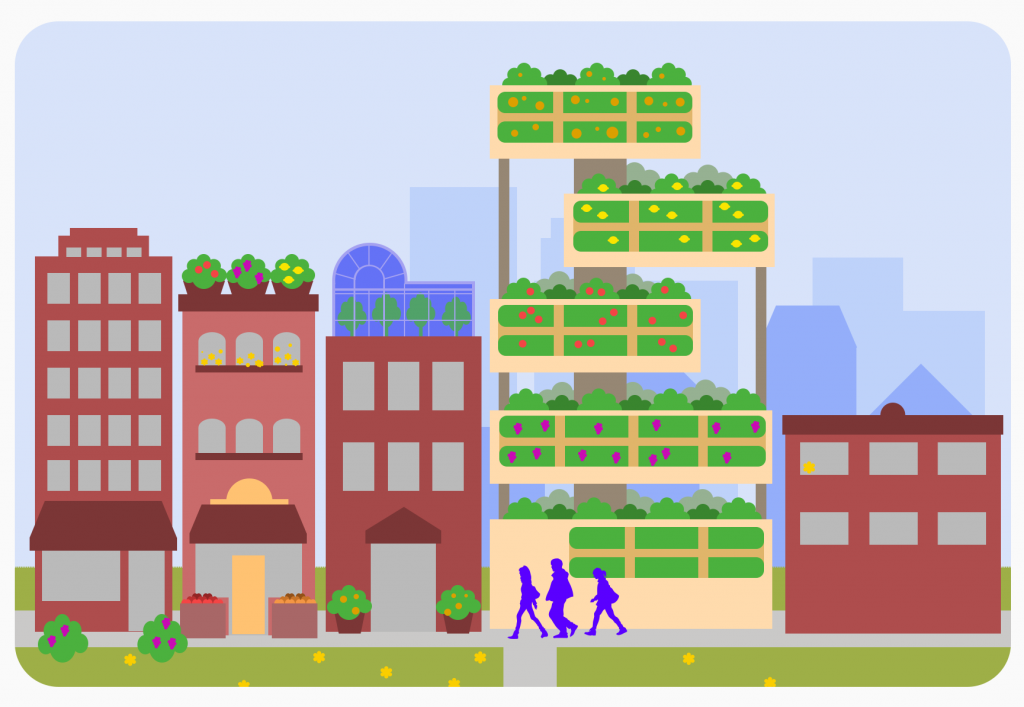
“This unit is all about the global food supply. We will learn about how we grow the food that everyone needs to be healthy, and explore farming innovations in cities around the world. For our final project, you will design a 3-dimensional model of an innovative and sustainable farm for our city.”
Read Growing the Food We Need.
2. Discuss the questions below.
Discuss • What does a farm look like to you? Do you think all farms are like this? Why or why not?
• Why do you think it can be challenging to grow enough food for everyone? • Look at the highlighted parts of the food system wheel. What clues do they give us about what we will be learning in this unit?
• What topics on this page are you most curious about?
Tip Review the definition of food security from Unit 2.
Vocabulary
AGRICULTURE (noun) The practice of growing crops and raising animals for food. Example: Cities depend on agriculture for most of the food they eat.
CLIMATE (noun) The temperature and weather patterns of a place. Example: Some places have a hot and humid climate.
CROP (noun) Plants that are grown for people and animals to eat. Example: The farmer grew different crops such as cucumbers, tomatoes, and corn.
EFFICIENT (adjective) Working without wasting time, resources, or energy. Example: Our new efficient light bulbs need less electricity to produce light.
FOOD SECURITY (noun) Having access to a constant supply of healthy, nutritious food. Example: The school provided free breakfast to students every day to improve food security.
FOOD SYSTEM (noun) The steps involved in producing food: growing, processing, transporting, selling, buying, consuming, and disposing of food. Example: The global food system makes it possible to buy fruit that grows in faraway countries.
INNOVATION (noun) A new tool or way of doing something. Example: The vertical farm is an innovation that helps people grow food in cities.
SUSTAINABLE (adjective) Taking care of people’s needs without harming the environment, such as by using fewer resources. Example: Farmers who practice sustainable agriculture find ways to grow food using less water.The global depends on people who work in .
Each that is produced grows best in its own special . To keep our food system secure, people are creating new to help us grow the food we need in a more and way. These innovations improve in communities around the world.
SEEDS ( NOUN ) the fertilized, matured ovule of a flowering plant, containing an embryo or rudimentary plant.
SOIL ( NOUN ) the upper layer of earth in which plants grow, a black or dark brown material typically consisting of a mixture of organic remains.
SAND, CLAY ( NOUN ). . 1. a. Small loose grains of worn or disintegrated rock. b. Geology A sedimentary material, finer than a granule and coarser than silt, with grains…
FOOD SUPPLY ( NOUN ). a stock of food supplied or available for use.